
In brief
- Anthropic moved its main monorepo off git to Scion, a new in-house version control system.
- Merged code changes jumped from about 2,500 a day in May to over 30,000 in September.
- A seven-person team built it with Claude and finished the migration in five months.
Anthropic has replaced git, the tool most of the world’s developers rely on, with its own system called Scion, because its AI agents now write more code than git can handle.
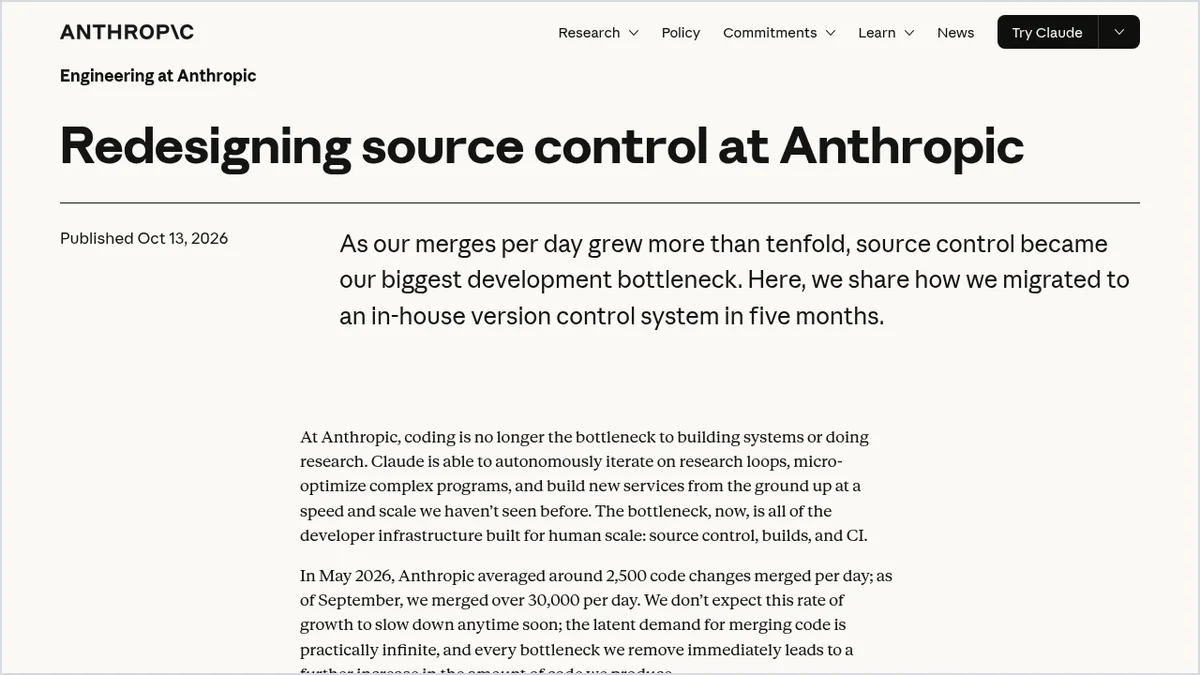
The company shared the details on October 13, 2026, on its engineering blog. Writing code is no longer the bottleneck, it says; the problem is developer infrastructure built for human scale, including source control, builds and continuous integration (CI).
From 2,500 to 30,000 merges a day
In May 2026, Anthropic merged about 2,500 code changes per day on average. By September it was merging more than 30,000, and the company does not expect that growth to slow.
| Metric | According to Anthropic |
|---|---|
| History of the main branch | Almost 100 GB |
| Compressed working copy | Over 25 GB |
| Code checkouts per day for CI | On the order of 25 million |
| Daily traffic if every checkout were a full fetch | Over 600 PB |
At its peak, the company ran several hundred internal git mirrors to keep up. That bought time, but it stopped scaling as the merge rate kept climbing.
How Anthropic Scion works
Git is designed so every developer holds a full copy of the repository and can work offline. At Anthropic, nearly all of the clients are agents and automated jobs that are always online.
So in Scion, the server does most of the work: it creates commits, performs merges and answers questions like who last changed a line. A local machine only fetches the files it actually needs.
Anthropic says it built on lessons from similar systems at other tech giants, notably Google’s Piper and Meta’s Sapling.
The payoff: 200x less infrastructure
According to the company, Scion’s footprint is 200x smaller than its old git mirroring setup in CPU and memory. CI and research jobs now check out code in seconds instead of minutes, and CI alone freed up 25% of its CPU capacity.
Alongside Scion, the team built a code review tool called Antique, code search and a detailed permissions system. All of this happened while daily merges grew tenfold.
What Claude did, and what was left to humans
One example from the post: the team asked an early internal snapshot of Claude Mythos Preview to rewrite a component that had been written by hand. The new version used 20x less memory and ran 4x faster.
Every engineer on the project now rates Claude as better than them at writing code, Anthropic says. Their job has shifted to design decisions and, quite often, telling Claude “no.”
Claude helps with operations too. Copies of Claude in Slack channels each watch a single component of the system, and Anthropic calls them “superfans.”
What we don’t know yet
- Anthropic did not say how much of Scion’s code Claude actually wrote.
- The cost of the migration and the tokens spent on it were not disclosed.
- The company mentions working with GitHub, GitLab and the open-source community, with no concrete steps announced.
What it means for you
- Developers: git is not going anywhere. Anthropic says Scion only makes sense for enormous monorepos, and that it would be hard to offer in a form useful to other companies.
- Teams using coding agents like Claude Code: Anthropic expects similar scaling problems to reach other companies within 6 to 12 months. It is worth tracking CI and build times now.
- For git platforms: Anthropic suggests richer server-side APIs and smarter fetch protocols that could help git scale without leaving its model.
- New to Claude? Our complete Claude guide covers the plans and the coding tools.
More on Maitz
Sources
- Anthropic Engineering: “Redesigning source control at Anthropic,” October 13, 2026
- Anthropic on its official X account, October 13, 2026

