
Anthropic released Claude Haiku 5.5 on October 7, 2026, the new generation of the smallest model in the Claude family. The company calls it the cheapest, fastest and most capable small model it has ever shipped. It is built for repetitive, high-volume work where cost matters: summaries, compacting long conversations, database queries and classification. Anthropic says it is also its fastest model to date at standard speed, which makes it a fit for live customer support and automated browser use.
One use Anthropic highlights is working as a subagent. A larger model such as Opus 5.5 or Sonnet 5.5 runs the overall task while Haiku 5.5 handles the small, quick pieces, such as pulling one figure out of a long document. Alongside the launch, Anthropic also cut a Sonnet 5.5 price and announced monthly API credits for subscribers, covered below.
What it costs
According to Anthropic, running Haiku 5.5 costs about 75% less on average than running Haiku 4.5. Pricing depends on prompt length. For requests up to 100,000 tokens, which Anthropic says made up about 90% of Haiku 4.5 requests, the price is 90% lower. Above 100,000 tokens, it is 50% lower. The model uses an updated tokenizer, so a typical task consumes slightly more tokens, and the 75% figure already accounts for that. Prices per million tokens:
- Input: $0.10 up to 100,000 tokens and $0.50 above that. Haiku 4.5 was $1, and Sonnet 5.5 is $2.
- Output: $0.50 up to 100,000 tokens and $2.50 above that. Haiku 4.5 was $5, and Sonnet 5.5 is $10.
- Cache reads: $0.01 and $0.05. Cache writes: $0.125 and $0.625.
What it can do
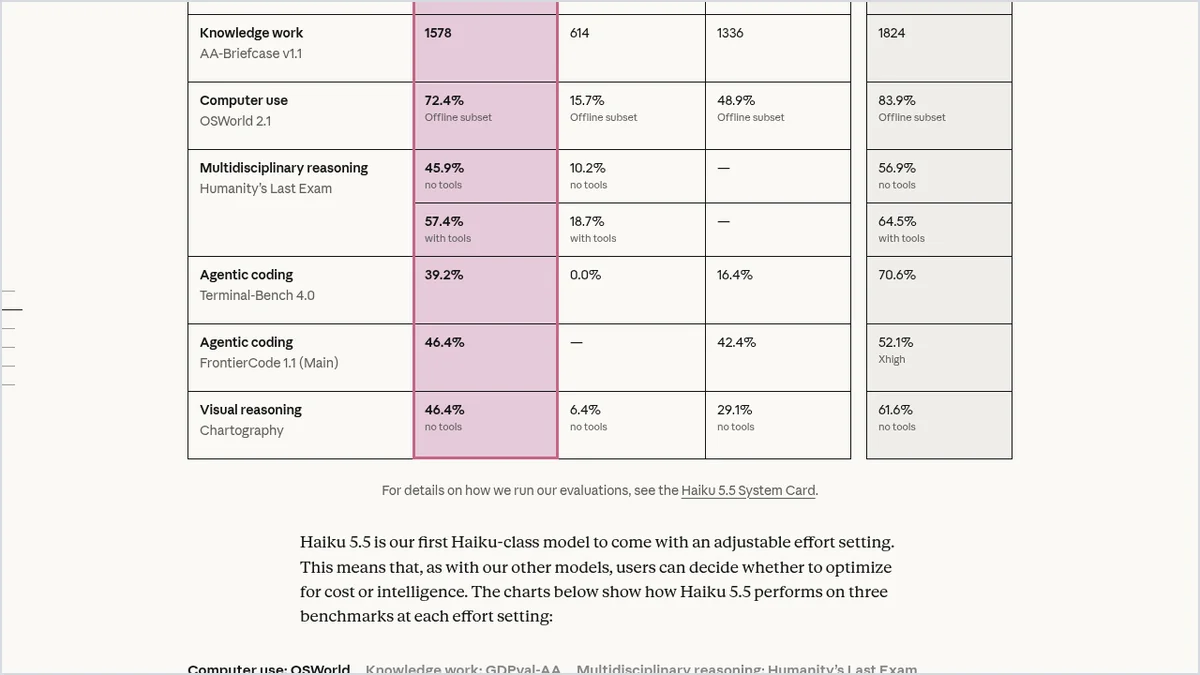
Anthropic published benchmark comparisons against Haiku 4.5, Sonnet 5.5 and OpenAI’s GPT-6 Luna. On computer use (OSWorld 2.1, offline subset), Haiku 5.5 scored 72.4%, compared with 15.7% for Haiku 4.5, 48.9% for GPT-6 Luna and 83.9% for Sonnet 5.5. On agentic coding in the terminal (Terminal-Bench 4.0), it reached 39.2%, versus 0% for Haiku 4.5 and 70.6% for Sonnet 5.5. On Humanity’s Last Exam, an expert-level knowledge test, it scored 45.9% without tools. These are the company’s own figures.
It is also the first Haiku model with an adjustable effort setting, from low to max, so users can trade cost for more intelligence. Anthropic adds a caveat: for complex agentic coding, Sonnet 5.5 and Opus 5.5 remain the better choices, and Haiku 5.5 is best for narrowly scoped tasks that used to be too expensive. The company says early-access customers reported similar results. HubSpot, for example, reported a 92.8% score on its internal CRM test suite, and Box said the model scored 11 points higher than Haiku 4.5 at about half the latency.
Safety
Anthropic says Haiku 5.5 improves on Haiku 4.5 across most of its alignment evaluations, with fewer cases of misaligned behavior and less willingness to cooperate with misuse. Its cybersecurity safeguards are stricter than Haiku 4.5’s but somewhat looser than those on the company’s other recent models. They allow a wider range of defensive work while still blocking penetration testing and other techniques more likely to be used by attackers. Organizations that need broader access can apply to Anthropic’s Cyber Verification Program or its life sciences counterpart.
More news: cheaper Sonnet 5.5 and API credits for subscribers
- Cache reads on Claude Sonnet 5.5 are now 50% cheaper, down from $0.20 to $0.10 per million tokens. Anthropic says this makes Sonnet 5.5 about 20% cheaper on most agentic work.
- This week, Anthropic is rolling out a monthly API credit for the Claude Platform: $100 for Max 5x subscribers, $200 for Max 20x, and up to $500 for Team plans, pooled across users. The credit works with any model.
- The Claude Python and TypeScript SDKs are adding computer use and browser use support in beta.
What it means for you
- Who is affected: mainly developers and businesses that send large numbers of small requests through the API, such as support bots, ticket routing and document summaries. GitHub Copilot Pro, Pro+, Max, Business and Enterprise users can pick it in the model picker as it rolls out gradually.
- What to do now: if you use Haiku 4.5, try the model as claude-haiku-5-5 and compare cost and quality on your own workloads. For complex coding work, stick with Sonnet or Opus. Max and Team subscribers should look for the new credit in their API account.
- Price and availability: from $0.10 per million input tokens. It is available now on the Claude Platform, Amazon Web Services, Google Cloud and Microsoft Azure, so US, EU and UK teams can use it through the cloud they already work with. Anthropic did not announce any regional restrictions.
- New to Claude? Plans, models and use cases are covered in our complete Claude guide, and more updates are in AI News.
Sources
- Anthropic, official website: Introducing Claude Haiku 5.5, October 7, 2026
- GitHub Changelog: Claude Haiku 5.5 in GitHub Copilot, October 7, 2026

