Two major AI companies announced large financial commitments to US scientific research on October 8, 2026. NVIDIA announced commitments valued at $1 billion over the next five years, and Anthropic pledged $150 million over three years. Both were announced at the Science: A New Golden Age event in Washington, D.C., hosted by the White House Office of Science and Technology Policy (OSTP), and both tie into the Genesis Mission, a federal initiative to speed up scientific and technological discovery with AI.
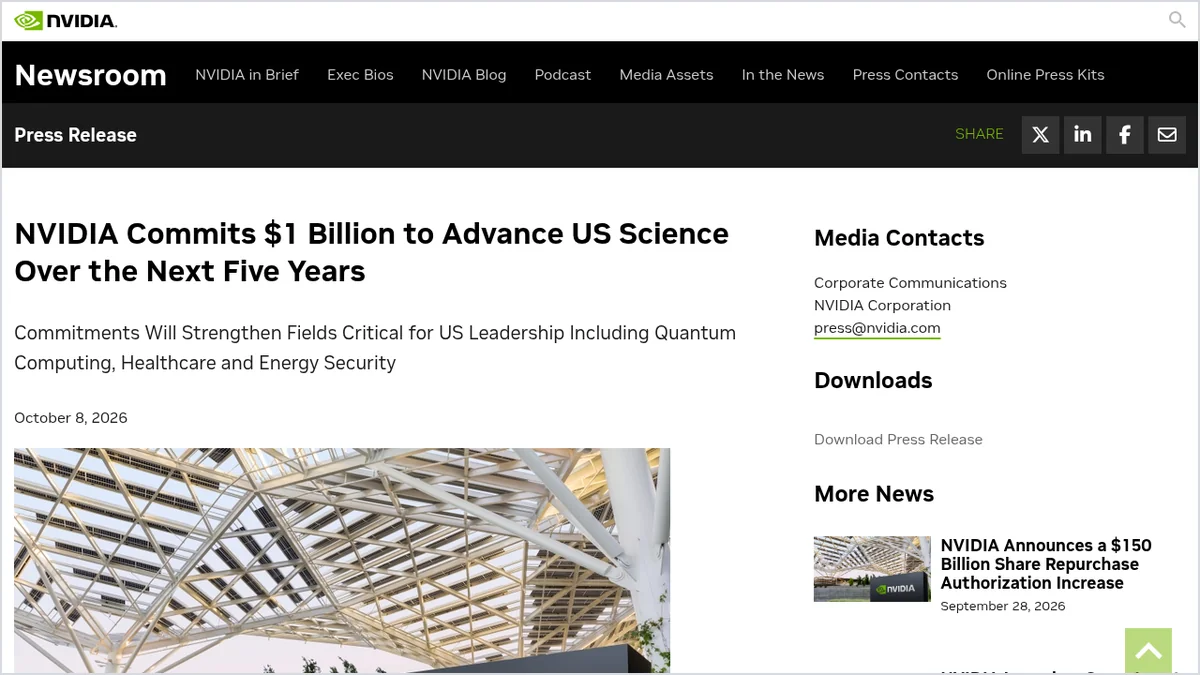
NVIDIA: $1 billion over five years
NVIDIA says the commitments are meant to build US capacity for what it calls super intelligence research and development in fields critical to US leadership, including quantum computing, healthcare and energy security. The money will flow through three channels: support for higher-education research institutions, investments in accelerating US quantum leadership, and support for cloud service providers serving US government mission needs.
NVIDIA also says it is a collaborator on several of the phase 2 Genesis Mission awards announced at the event, in quantum computing, fusion, accelerator design and microelectronics. The company has worked with US national labs for more than two decades. Last year it announced a partnership with the US Department of Energy on the Genesis Mission that includes building the department’s largest supercomputer for scientific research at Argonne National Laboratory, along with support for seven new systems at Argonne and Los Alamos. NVIDIA CEO Jensen Huang said the investment puts advanced tools in the hands of scientists to accelerate breakthroughs in medicine, energy and materials.
Anthropic: $150 million and Claude for 15+ agencies
Anthropic committed $150 million over three years to the Genesis Mission. The company says the funding will make Claude available to more than 15 agencies taking part in the mission, including NASA, the National Institutes of Health and the National Science Foundation. It first announced its partnership with the Department of Energy and the Genesis Mission last December and has since worked with the department to bring Claude to scientists across the national labs.
Over the next three years, Anthropic plans to:
- Provide Claude, Claude Code and API credits to several hundred Genesis Mission research projects.
- Partner with agencies and national labs on the administration’s top science priorities, including fusion energy and quantum computing.
- Offer training, onboarding and technical support to scientists on the projects, and help agencies new to the mission get their first projects running.
The company also points to earlier steps: Claude Science, a research workbench that brings together the tools researchers use most, 10,000 free and discounted Claude seats for academic scientists, an expanded AI for Science program that gives credits to high-impact projects, and a research preview of the Model Hardware Standard, a shared specification meant to let AI agents operate lab instruments safely.
What it means for you
- Who is affected: mainly scientists at US federal agencies and national labs. These are multi-year commitments, not a product you can try today.
- Researchers outside the agencies: Anthropic mentions Claude Science and its free and discounted academic seats, but the announcement does not explain how to apply.
- Outside the US: both announcements focus on US research. Neither mentions programs for researchers in the EU or UK.
- Want to know the tools behind the headlines? Our AI tools directory covers Claude and more, and our RTX Spark story covers NVIDIA’s latest PC announcement. More updates are in AI News.
Sources
- NVIDIA Newsroom: NVIDIA Commits $1 Billion to Advance US Science Over the Next Five Years, October 8, 2026
- Anthropic, official website: Building on our commitment to American scientific discovery, October 8, 2026