Google Will Fund Upgrades at Six US Nuclear Plants to Power Its Data Centers
A new deal with Constellation Energy will add about 890 MW from existing reactors to the PJM grid by 2032, and Constellation will use Gemini Enterprise to plan the upgrades. Google says it has now enabled over 1.5 GW of new US nuclear capacity.
Maitz Editorial Team·
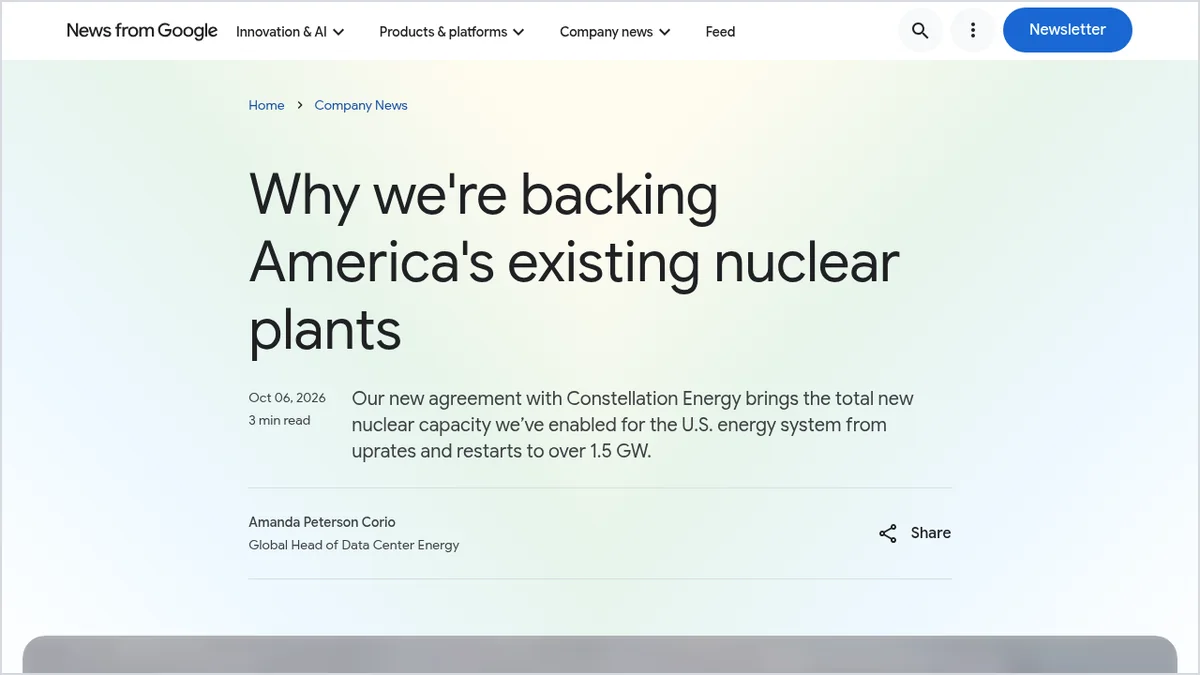
Google announced on October 6, 2026 a new energy deal with Constellation Energy, a US nuclear plant operator. Google will finance upgrades at six operating nuclear plants in Illinois, Pennsylvania and New Jersey that are set to add 890 megawatts of clean, around-the-clock power to the grid. As part of the deal, Constellation will also use Google Cloud’s Gemini Enterprise to plan and run the work.
Screenshot: Google’s official blog
Google is open about the reason: the growth of its data centers, which run, among other things, its AI models. The deal is one more sign of how hard AI companies are working to lock in power for the years ahead.
What the deal covers
890 MW by the end of 2032: the upgrades span 11 Constellation reactors. Google says that is roughly equivalent to adding a whole new large reactor to the grid, years faster than building one from scratch.
Upgrades, not new builds: a nuclear uprate modernizes turbines, steam generators and digital control systems so an existing reactor can produce more power.
Google as anchor customer: a long-term power purchase agreement (PPA) gives Constellation the revenue certainty to invest. Google says other grid customers will not bear any of the costs.
The grid: the power goes to PJM, which spans 13 states across the Mid-Atlantic and Midwest and serves 67 million Americans.
Jobs: Google says the projects will sustain about 4,400 existing jobs and support roughly 7,200 new construction jobs.
Where AI comes in
Beyond the power itself, Constellation is deploying Gemini Enterprise agentic workflows across its core operations to speed up uprate planning, streamline construction and optimize plant output. In other words, the same AI that consumes the electricity is meant to help bring new capacity online faster. Google did not share figures on savings or results from using Gemini.
The bigger picture: 1.5 GW of nuclear
With this agreement, Google says it has now enabled more than 1.5 GW of new nuclear capacity in the US by uprating existing reactors and restarting dormant ones. The US Department of Energy has set a goal of 5 GW from uprates and restarts by 2030, and Google expects its agreements to cover nearly 25% of that by the end of the decade. Its other deals include:
Georgia: an agreement with Georgia Power to support uprates at four reactor units, expected to deliver about $900 million in ratepayer benefits.
Iowa: work with NextEra Energy to restart the Duane Arnold Energy Center, bringing more than 600 MW of carbon-free power back online.
Tennessee: a partnership with Kairos Power and the Tennessee Valley Authority (TVA) to deploy advanced reactors in Oak Ridge.
Why it matters
Training and running AI models takes enormous amounts of electricity, and access to power has become one of the main limits on data center growth in the US and Europe. This deal shows Google favoring the fastest route for now: squeezing more output from existing plants instead of waiting years for new reactors. It sits alongside its longer-term bets such as Project Suncatcher, its plan for AI compute in orbit. For businesses weighing Gemini Enterprise, the Constellation rollout is also a high-profile test of agentic AI in a heavily regulated industry. Follow AI News for more, including our coverage of Gemini 4 Argon.
With your permission, we use cookies and similar technologies to measure how the site is used with Google Analytics, and to show, personalize and measure ads with Google AdSense, based on the preferences you choose. You can keep browsing without analytics or ads, accept both purposes, or choose each purpose separately. You can change or withdraw your choice at any time via “Privacy preferences”.
Essential
Always active
The technical storage or access is strictly necessary to provide a service you explicitly requested, or to carry a communication over a network.
Preferences
The technical storage or access is necessary for the legitimate purpose of storing preferences that are not requested by the subscriber or user.
Statistics
The technical storage or access is used exclusively for statistical purposes.The technical storage or access that is used exclusively for anonymous statistical purposes. Without a subpoena, voluntary compliance on the part of your Internet Service Provider, or additional records from a third party, information stored or retrieved for this purpose alone cannot usually be used to identify you.
Advertising (Google AdSense)
The technical storage or access is used to create user profiles to show advertising, or to track your use of one or more websites for similar marketing purposes.