בקצרה
- Google’s new flagship model, Gemini 4 Argon, is going first to a small group of cybersecurity defenders. Here is what Google says it can do, what it will cost and why it is holding back a wider release.
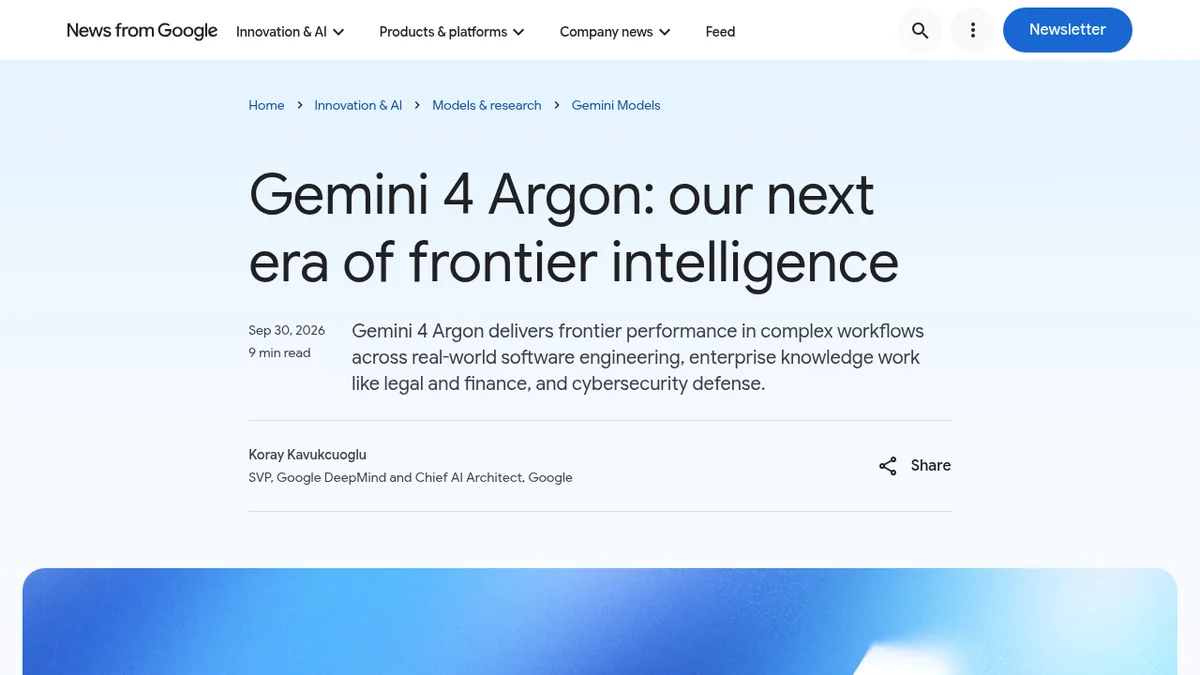
Google announced Gemini 4 Argon on September 30, 2026. It is the first model in the Gemini 4 generation and the company’s new flagship. The announcement on Google’s official blog was written by Koray Kavukcuoglu, SVP at Google DeepMind and Google’s Chief AI Architect, and it presents a model built for long, complex work: software engineering, knowledge work in fields such as law and finance, and cybersecurity defense.
For current plans, prices and every Maitz article on Gemini, see our Gemini hub.
The real news is what Google is not doing. Argon is not open to the public. It is rolling out first to a group of trusted cyber defenders through what Google calls the Fairwind Program. Google says releasing capabilities at this level requires a phased approach, and that it is taking part in the US government’s voluntary process for pre-release model access. Developers, businesses and consumers will get Argon only after Google gathers feedback and improves its safeguards, starting with paid API customers and Google AI Ultra subscribers. No date has been given.
What Argon is supposed to do better
According to Google, thousands of its employees already use the model. The examples it gives include Argon agents that analyzed performance data across Google’s data centers and freed up more than 300 TiB of memory, and a migration of C and C++ code to Rust, from libraries such as re2 and libgav1 up to the Zircon kernel of Fuchsia, which runs to more than 800,000 lines. Google stresses that these rewrites go through automated and manual review before they reach production.
One notable technical change is output length. Argon can produce up to one million tokens in a single run, up from 64,000 before, which gives it far more room to reason and write before it finishes a task. Google also reports benchmark results, including 77.9% on DeepSWE v1.1, which measures long software engineering tasks, and 91.7% on LVBench, which measures understanding of long videos. These are the company’s own figures, and while the model remains closed they are hard to check independently.
Why cybersecurity comes first
Google trained Argon to find, validate and patch security vulnerabilities on its own. For trusted defenders and its internal teams, Google is providing the model without its usual cyber guardrails. The company says Wiz is already using Argon in its Scan for Good program, and that in an early demonstration the model found a critical vulnerability exposing sensitive personal information in healthcare software used by hospitals around the world.
The same capability is the reason for caution. Google lists four areas where it is strengthening safeguards before a broad release:
- Refusing requests that could help with cyberattacks or with chemical, biological, radiological or nuclear weapons.
- Resisting prompt injection, where malicious instructions hidden in content the model reads try to take over its behavior.
- Monitoring the model’s chain of thought and actions, and stopping it if it goes beyond what the user asked for.
- Hardening and isolating the environments used for training and testing.
What it will cost
During the launch period, Argon will cost $2 per million input tokens and $10 per million output tokens, with a 95% discount on cached input. After the introductory period, the price rises to $4 and $20 respectively. Google has not said how long the introductory period will last.
What it means right now
In practical terms, very little yet: most users and developers cannot try Argon. The direction is clear, though. New frontier models are increasingly judged by how long they can work on a single task, not by how quickly they answer a question. If you already work with coding agents, for example by following our Claude Code guide, expect the competition to focus on exactly that. We will follow up in AI News when Google opens the model to a wider audience.
Sources
- Google, official blog (The Keyword): Gemini 4 Argon: our next era of frontier intelligence, September 30, 2026

