- Microsoft unveiled Maia 300, the third generation of its Azure AI chip, built first and foremost for running models (inference).
- Microsoft expects about 40% more tokens per megawatt than leading GPU-based systems, with production deployments starting in 2027.
- Maia 200 already serves Microsoft Copilot in production, with GitHub Copilot and Microsoft Foundry to follow by the end of the year.
On October 12, 2026, Microsoft announced Microsoft Maia 300, the third generation of its Azure Maia chip program. The company says it will scale the Maia family to multi-gigawatt deployments starting in 2027, making Maia the primary inference system for Microsoft products and services. The announcement came from Scott Guthrie, executive vice president of Microsoft’s Cloud + AI Group.
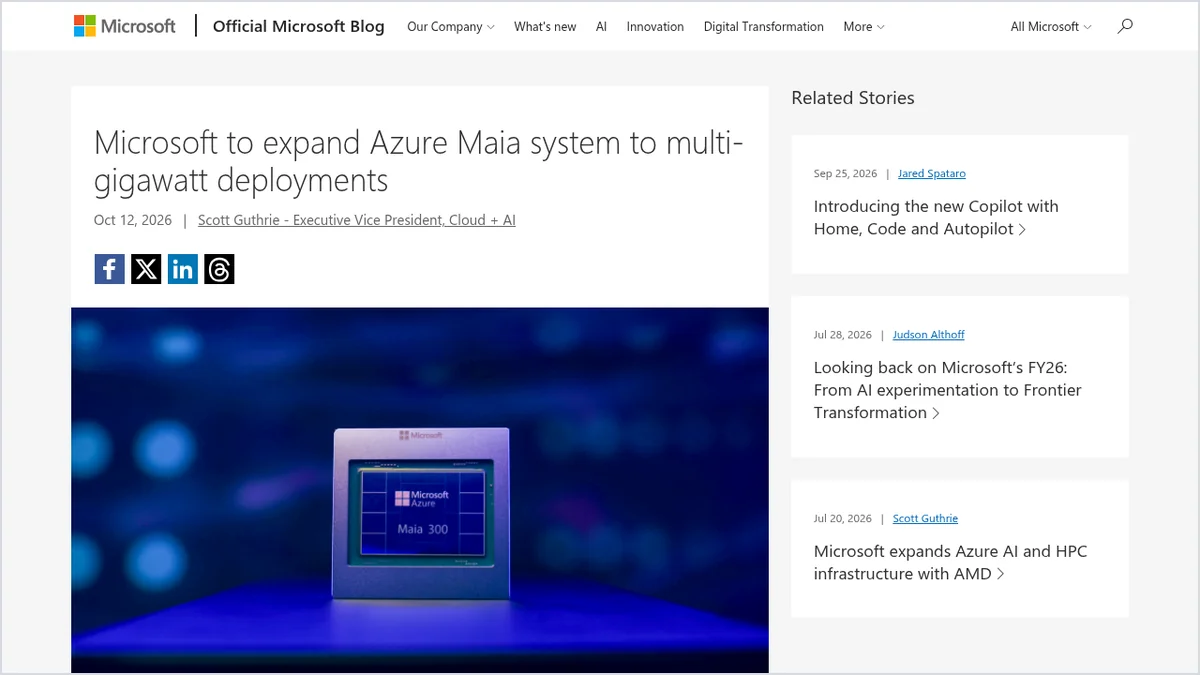
The headline is that the chip is designed around serving models rather than training them. Microsoft points to newer workloads such as long-context reasoning, latency-sensitive conversations, and sustained, multi-step agentic tasks. In those workloads, the company argues, moving data between memory and compute is increasingly the bottleneck, more than raw compute power.
Inside Microsoft Maia 300
According to Microsoft, each Maia 300 chip pairs eight HBM4 stacks for 18.0 TB/s of peak memory bandwidth with a 950-watt thermal design power. It uses a multi-chiplet design that separates compute, memory-controller, and I/O functions, and its compute chiplets are built on TSMC’s N2P process. On-die SRAM works as a software-managed scratchpad to take pressure off HBM.
The chip is designed for low-precision formats, including an enhanced MXFP4. Microsoft says this cuts memory and bandwidth needs for both computation and KV-cache storage, which allows larger context windows and higher throughput within the same power envelope. The company also says AI-assisted kernel optimization helps it squeeze more useful work out of the hardware.
At rack scale, a Maia 300 system brings together 96 accelerators in a 167-kilowatt power envelope, with 27.6 TB of HBM capacity and 1.7 PB/s of aggregate HBM bandwidth. Accelerators talk over Ethernet-based infrastructure with a custom AI transport, meant to scale from a single rack to a full datacenter. Microsoft says the full 96-accelerator configuration delivers up to 7x the rack-scale token throughput of Maia 200.
Maia 200 is already in production
Microsoft stresses that Maia 200 already serves production workloads, including Microsoft Copilot, and supports the MAI team as it develops the company’s next-generation models. Maia 200 runs OpenAI models, Microsoft’s own MAI models, and leading open-source model families. It is deploying across the United States, Europe, and Australia, and Microsoft says it delivers up to 1.7x more tokens per watt for built-in AI in Teams, Copilot, and Cowork compared with leading GPU infrastructure.
Together, the two generations are meant to support more services: multi-step agentic work that helps GitHub deliver coding experiences more efficiently, cloud-scale model serving for Microsoft Foundry, inference and data generation for the MAI team, and fast interactions for Dragon Copilot, which aims to reduce clinicians’ administrative work. Microsoft says it will share more at Microsoft Ignite 2026 next month in San Francisco and online.
This is not Microsoft’s only AI hardware news this month. We recently covered NVIDIA RTX Spark for Windows PCs, which brings local AI agents to personal computers. Maia 300 is the other side of that effort: the cloud that runs Microsoft’s services.
What it means for you
- Copilot and Teams users: nothing to do. The change happens behind the scenes, and Microsoft frames it as a way to run more AI features on less power.
- Developers on GitHub Copilot or Microsoft Foundry: Maia 200 is set to start serving both by the end of the year. Microsoft did not announce USD pricing or plan changes tied to the move.
- Availability: Maia 200 is deploying across the United States, Europe, and Australia (Microsoft did not break out the UK separately). No region list has been published for Maia 300, which begins production deployments in 2027.
- Comparing the AI tools that run on this kind of infrastructure? See our AI tools directory, and more updates in AI News.
Sources
- Official Microsoft Blog: Microsoft to expand Azure Maia system to multi-gigawatt deployments, by Scott Guthrie, October 12, 2026
- Microsoft Source: Introducing Microsoft’s latest custom chip: Maia 300, October 12, 2026

