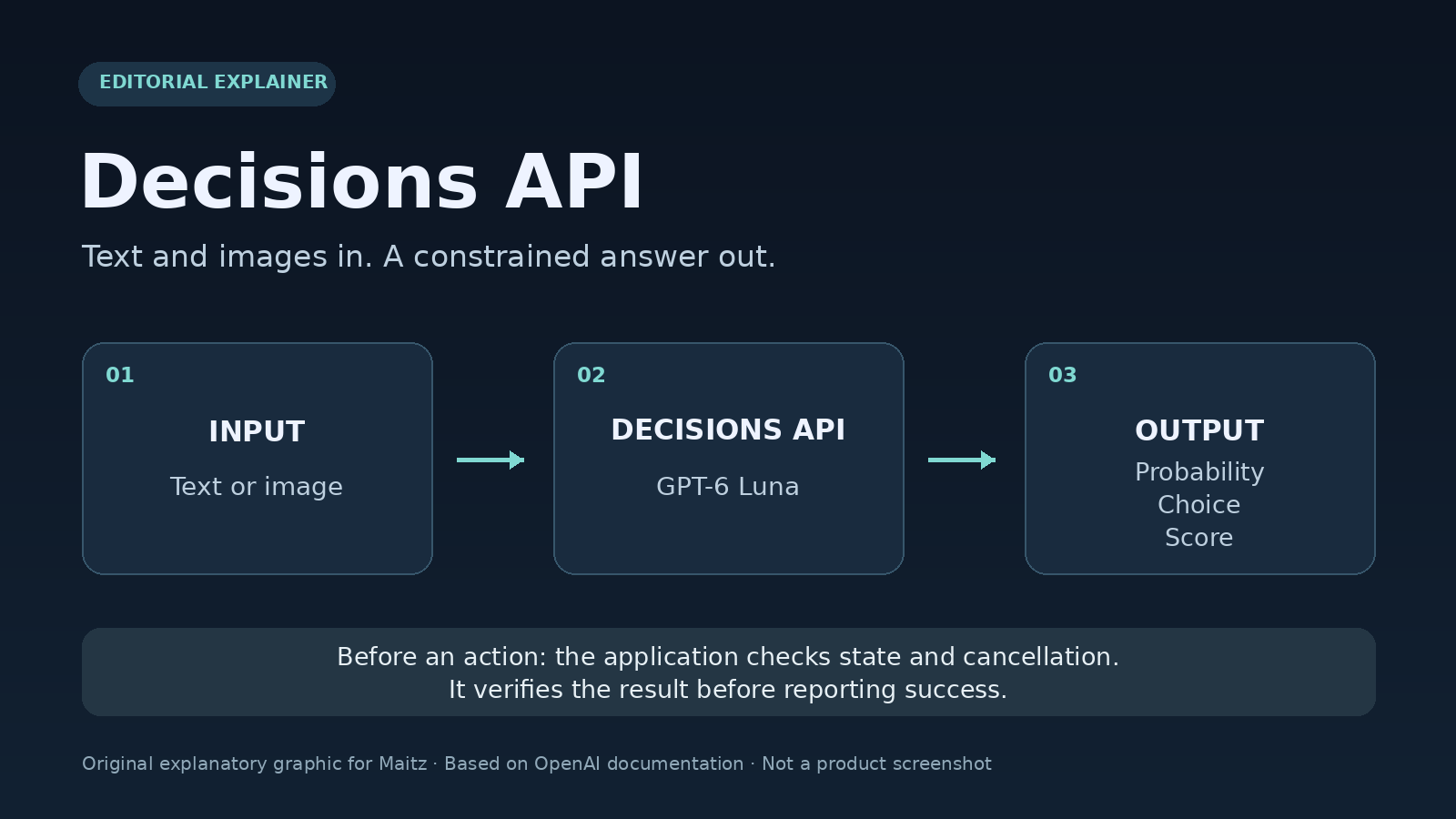
OpenAI launched the Decisions API in public beta on October 6, 2026. The new interface lets applications obtain a defined answer from text and images, for example to sort incoming requests or choose a next step. It currently works with GPT-6 Luna. According to the company, responses arrive roughly ten times faster than through the Responses API. This is OpenAI’s figure and was not independently tested for this article.
Developers can request three types of output: an estimate of the probability that a condition is met, a selection from options they have supplied, or a score on a scale they define. Applications could, for example, route a request to the right department, identify damage in a product photo or assess the severity of a fault. Multiple questions can also be asked about the same input in a single request.
One use case demonstrated by OpenAI is integration with a voice conversation. GPT-Live continues speaking and listening while the application sends the user’s request and its current state to Decisions. In a browser example, a request to refresh a page is checked against three options: go back, refresh or take no action. After an option is selected, the application handles execution and returns the result to the conversation. The documentation instructs developers to skip an action that has been canceled or no longer fits the application’s state.
The same mechanism can also work in a presentation: a request to move to the next slide is routed to an available action, while a request to compare plans is sent to a model suited to analysis. Selection is one step in a process built by the developer; the application still needs to check the system’s state, handle cancellations and verify that an action succeeded before reporting success to the user.
The documented price is $0.10 per million input tokens, with no charge for output tokens or cache reads and writes. This rate applies only to the Decisions endpoint; other uses of GPT-6 Luna are priced separately. Regional-processing and long-context surcharges may apply. The service remains in public beta.
For product developers, the interesting addition is a focused interface for the small decisions that recur throughout a workflow. Its practical value will also depend on classification quality: OpenAI recommends setting thresholds using labeled examples from the application, taking the cost of mistakes into account. Before connecting it to a live workflow, it is worth testing what happens when a request is ambiguous, information is missing or the predefined options do not fit. Speed alone is not a sufficient measure of product quality.

