OpenAI and Atlassian Expand Partnership: GPT-6 Models Will Power Agents in Jira, Confluence and Rovo
Under a new agreement, OpenAI’s GPT-6 models will power agents in Rovo and across Atlassian’s platform, while new plugins bring Jira work items and Confluence content straight into ChatGPT and Codex. More than 3,000 Atlassian developers already use Codex.
Maitz Editorial Team·
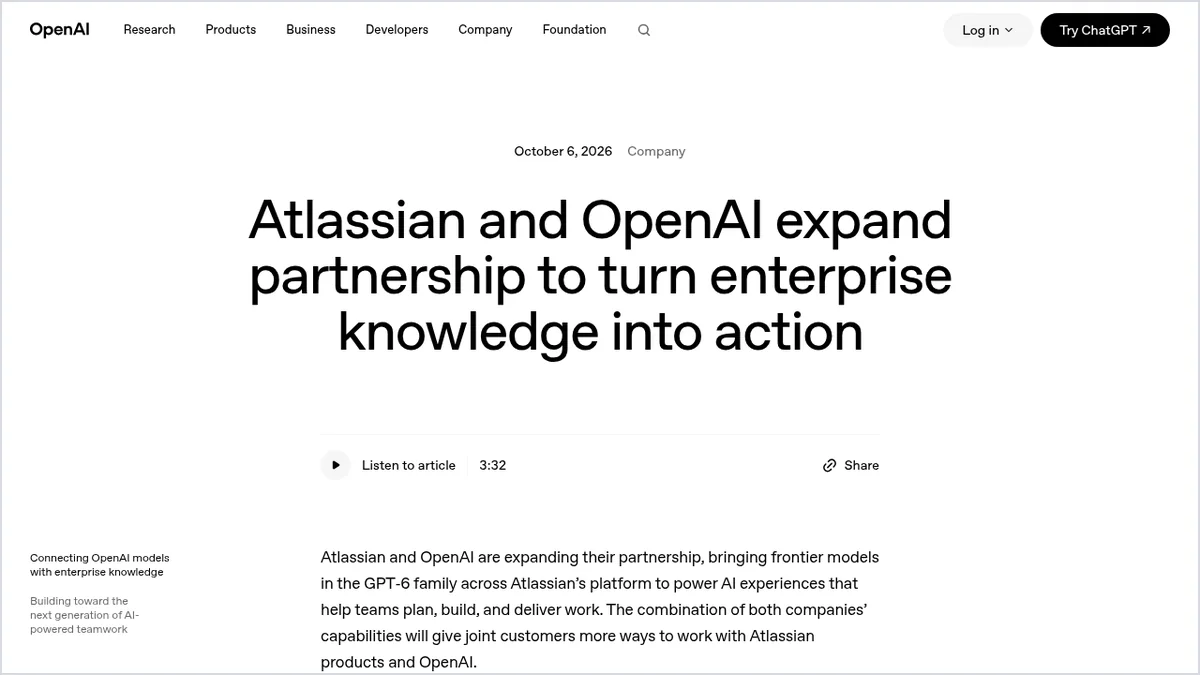
OpenAI and Atlassian, the company behind Jira and Confluence, announced an expanded partnership on October 6, 2026. Under the new agreement, frontier models from OpenAI’s GPT-6 family will power AI agents across Atlassian’s platform, most notably in Rovo, Atlassian’s AI layer. At the same time, Atlassian is widening its own internal use of Codex and ChatGPT Enterprise.
Screenshot: OpenAI’s official blog
The core idea is grounding the models in company context. Rovo runs on Atlassian’s Teamwork Graph, which maps the people, projects, documents and decisions inside an organization. With that context, a language model can answer questions about the actual work, not just general knowledge.
What the deal covers
Agents built on GPT-6 models: OpenAI models will power agents in Rovo and across Atlassian’s products through the OpenAI API, so model upgrades reach customers inside tools they already use.
Access to the newest models: OpenAI says Atlassian gets expanded access to its latest frontier models, including GPT-6 Astra and the GPT-5.6 series.
Jira and Confluence inside ChatGPT and Codex: Atlassian and Teamwork Graph plugins bring Jira work items, Confluence content and people directly into ChatGPT conversations and Codex sessions, subject to each organization’s existing permissions.
Dogfooding on both sides: more than 3,000 Atlassian developers already use Codex in their terminals, IDEs and code reviews, according to the announcement, while OpenAI continues to run critical internal workflows on Jira.
What it looks like in practice
OpenAI’s example: a product manager preparing for a launch asks Rovo whether the team is on track. Rovo pulls together the relevant Jira tickets, Confluence pages and related discussions, spots engineering blockers and missed milestones, and the OpenAI model turns it into a launch-readiness assessment with recommended next steps. The goal, the companies say, is less time spent hunting for scattered information.
What comes next
The two companies are exploring deeper Jira integrations that would let teams assign work to AI agents, track their progress, capture decisions and review results. Paired with DX, Atlassian’s developer productivity platform, engineering leaders could measure how AI affects development speed, cycle time and developer experience while keeping humans in control. For now this is a direction under exploration rather than a dated launch, and neither company announced new pricing.
Why it matters
The enterprise AI race is shifting from general chatbots to agents that understand how a specific company works. Anthropic is pushing the same way, as with Barclays’ Claude rollout, and OpenAI keeps expanding its GPT-6 lineup. For the many software and product teams in the US, UK and Europe that live in Jira and Confluence, it means OpenAI’s model capabilities show up in tools they already have open, with existing permissions still deciding what the AI can see. More updates in our AI News section.
With your permission, we use cookies and similar technologies to measure how the site is used with Google Analytics, and to show, personalize and measure ads with Google AdSense, based on the preferences you choose. You can keep browsing without analytics or ads, accept both purposes, or choose each purpose separately. You can change or withdraw your choice at any time via “Privacy preferences”.
Essential
Always active
The technical storage or access is strictly necessary to provide a service you explicitly requested, or to carry a communication over a network.
Preferences
The technical storage or access is necessary for the legitimate purpose of storing preferences that are not requested by the subscriber or user.
Statistics
The technical storage or access is used exclusively for statistical purposes.The technical storage or access that is used exclusively for anonymous statistical purposes. Without a subpoena, voluntary compliance on the part of your Internet Service Provider, or additional records from a third party, information stored or retrieved for this purpose alone cannot usually be used to identify you.
Advertising (Google AdSense)
The technical storage or access is used to create user profiles to show advertising, or to track your use of one or more websites for similar marketing purposes.