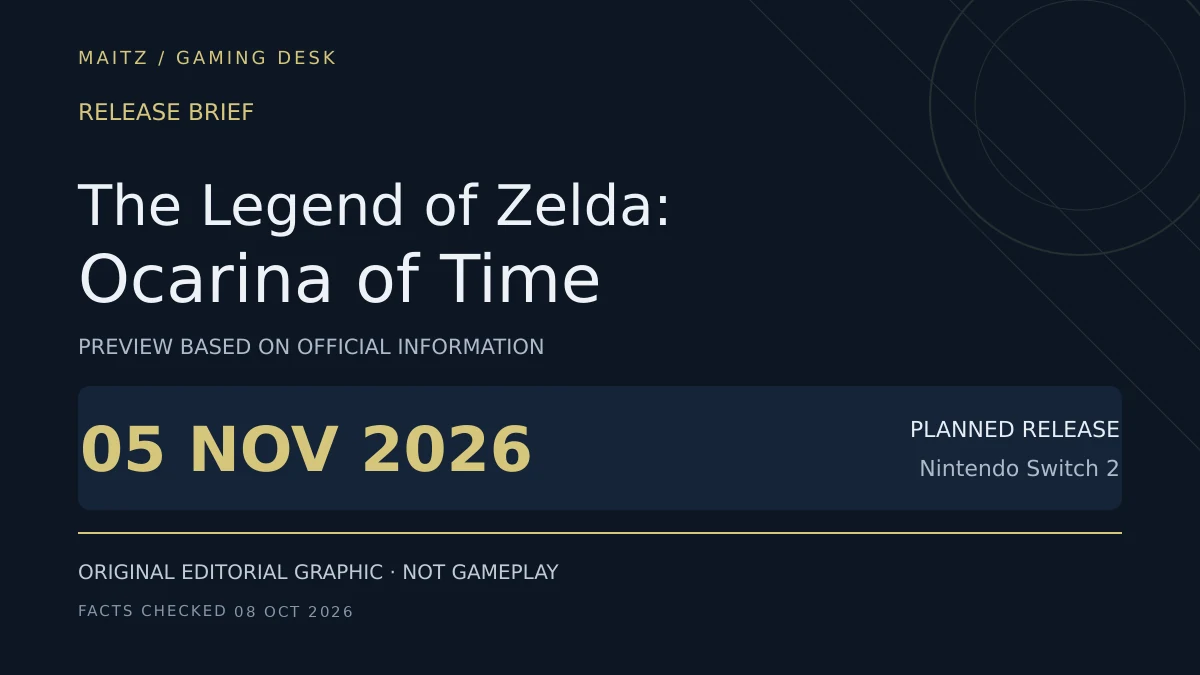
This return to Hyrule begins with a jump button. The Legend of Zelda: Ocarina of Time arrives on Nintendo Switch 2 on November 5, 2026, and the new version changes how players move through its world. Alongside the visual redesign, Nintendo has confirmed dashing, manual jumping and camera control with the right stick. Those are changes worth knowing about even if you remember the 1998 adventure well.
The game has been rebuilt for the new console. Voiced cutscenes, expanded dialogue and orchestral music are also part of the package. For first-time Ocarina of Time players, this is an opportunity to discover its story through a version designed around contemporary control habits. For returning players, the interesting question is how those additions will affect the pacing and the feeling of the journey.
An adventure across two eras
The story follows Link on a journey across Hyrule as Ganondorf pursues the Triforce. The adventure takes place across two eras, with some equipment available to Link in only one of them. Dungeons and temples combine enemies, puzzles and environmental obstacles, so progress also depends on understanding the tools you carry.
That structure has an obvious appeal for anyone who enjoys returning to a familiar place and seeing it differently. A good puzzle can prompt a player to reconsider a room they have already crossed, while a new item can change the meaning of an old obstacle. That is the kind of enjoyment to look for here: gradually getting to know a world and the possibilities within it.
Changes you will encounter between dungeons
According to Nintendo, the day-and-night cycle now continues inside towns, too. A system called Threads of Time provides a story recap and the next objective, alongside an illustrated tapestry that fills in during the journey. In practical terms, the game gives you somewhere to turn when you cannot remember where you left off.
For someone playing in short sessions a few evenings a week, that recap could be particularly useful. Taking a break need not mean spending the next session reconstructing the last conversation. The complete game will still need to be played to establish how detailed the guidance is and how it fits with the pleasure of discovering things independently.
Nintendo also details motion aiming for tools such as the slingshot and bow. Together with the new camera, that makes controls an important area for practical testing: is it easy to find the angle you want and move from looking to acting? The existence of a control option alone does not establish how comfortable it will be over time.
You can hum to the ocarina
The ocarina is a musical instrument with a role in play: the songs Link learns can open routes and change the time of day. In the new version, you can play using buttons or hum a learned melody into the Switch 2’s built-in microphone. The musical option sounds particularly fitting for a game in which remembering a tune can be part of the solution.
It is important to distinguish announced features from an assessment of them. This article does not offer hands-on impressions of humming recognition, game performance or control comfort. Those require time with the finished product, rather than simply watching a demonstration.
What to check before November 5
The remake is exclusive to Switch 2. The US store lists it as a single-player game supporting handheld, TV and tabletop play. The store page also publishes the supported language list. These are useful details for anyone considering it as their first game in the series or planning to share it with their household.
As of October 7, the reason to follow Ocarina of Time is clear: Nintendo is revisiting a familiar adventure with concrete changes to its controls and storytelling. November’s test will be simpler than any feature list: how enjoyable is it to set out, stop at a puzzle and want to keep going?