To stop a UFL attack before you need a tackle, practice four drills: buy time without chasing, defend the next pass, choose a tackle you can explain, and make three decisions after losing possession. Update 0.74.0 reduced automatic defensive assistance, so the drills focus on player selection and when to press.
This article is part of our complete UFL guide, which collects all of our coverage of the game.
Official documentation and original suggested drills as of October 7, 2026. For PC and consoles. No claim of hands-on testing or measured success rates.
Preparation know who you control
Update 0.74.0 reduced automatic defensive assistance and changed stamina consumption. The following drills focus on player selection and choosing when to press. Repetition counts and targets are our training recommendations.
Check the current mappings for player switching, Jockey, sprinting, standing tackles and sliding tackles. This guide does not guess button bindings: use the actions shown for your version and control layout. On PC, check the input device you actually use.
The 0.73.0 documentation lists two right-stick switching modes, Player Relative and Ball Relative, with sensitivity from 0 to 10. Choose one mode for the session and note it down. In a local match with a friend, ask them to move the ball from side to side. At each pass, identify the defender you want to select, switch and check who was selected. Do not change sensitivity after one mistake. The intended outcome is consistently recognizing the player you have switched to before their first movement.
Exercise one buy time without chasing
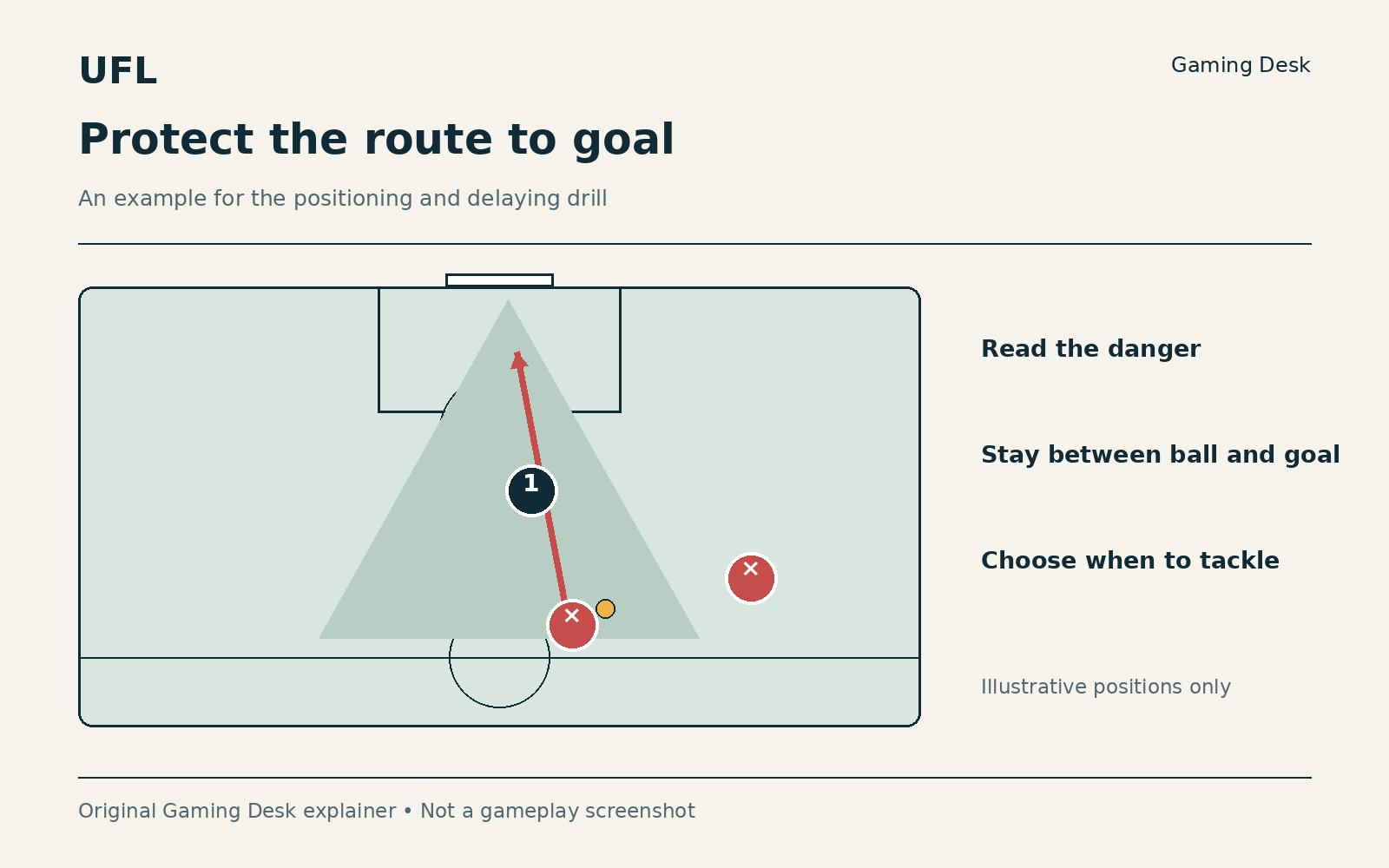
Start a situation in which an attacker advances towards a defender with some distance remaining to goal. Ask a friend to try getting past you on either side. Your task is to remain between the attacker and the center of the goal without immediately trying to win the ball. Let them choose a direction, try responding with a small movement and avoid a large panic-driven change of direction.
Make six attempts and switch sides of the pitch. Record whether the attacker beat you, whether you stayed in front of them and whether a central route opened. Do not measure this exercise by the number of tackles. The intended success is a delay that lets you understand the next move. If you get beaten, try again with less forward movement; if you remain too far away, begin a little closer.
Exercise two defend the next pass
The official season article describes interception reactions as depending partly on movement, distance from the ball’s path and Defense Awareness. It also identifies that attribute’s influence on Jockey. Good positioning does not guarantee an automatic interception.
Ask the attacker to choose between dribbling and passing to another player. Before approaching the ball, identify who threatens to receive centrally. Try positioning the player you control without opening a direct route to that receiver. When the ball moves, reassess who you should control. Run eight situations and record what you tried to block and what opened instead. The goal is to recognize the cost of each decision to press, rather than trying to cover every possibility with one player.
Exercise three choose a tackle you can explain
Return to the one-on-one and ask your friend to alternate between a close touch and a touch that moves the ball farther from them. On each attempt, decide beforehand whether to wait or attempt a standing tackle. Try tackling only when you identify a route to the ball. Do not use repeated button presses as a substitute for choosing the moment.
Record five possible outcomes: a clean recovery, a loose ball, a miss, a foul or a continued attack. Also check what happened immediately afterwards: did another defender remain between the opponent and the goal? Keep sliding tackles for a separate exercise with your friend so you can learn their consequences without mixing two actions. The training target is a reasoned decision; a fixed number of steps cannot guarantee a clean tackle.
Exercise four three decisions after losing possession
After losing the ball, ask in order: where is the immediate danger, who can delay it and who is protecting the space behind? Select a player accordingly instead of automatically switching to whoever is closest to the ball. If there is no reasonable chance of reaching the ball, practice retreating in a way that protects the route to goal.
Collect five midfield turnovers in a local match. For each, assess the first decision rather than only whether you eventually conceded. After regaining possession, look for an available pass before launching a fast break. In the latter part of the match, check player condition before another spell of pressure. You do not need a fixed pressing instruction for every situation; the exercise is about choosing when to chase and when to reorganise.
A short post-match diagnosis
Choose three situations in which you were exposed. For each, write down who you controlled, which route you tried to close and which action opened the defense. Distinguish selecting the wrong player from stepping out too early or mistiming a tackle. Choose just one issue for the next session so you can judge whether the change helped.
Update 0.74.1.1 documents a fix for a player failing to turn towards the ball and running backwards. If similar movement recurs in your game, check the version and save a clip with context; do not assume every malfunction is a tactical mistake, or every conceded goal a bug. Progress means fewer unnecessary openings of the same route over several matches, alongside quicker recognition of the player you control.
Sources
- UFL update archive
- Update Notes 0.74.1.2
- Update Notes 0.71.0
- Update Notes 0.73.0
- Update Notes 0.74.0
- UFL Season 26/27 — New Gameplay, New Possibilities
- Update Notes 0.74.1.1

