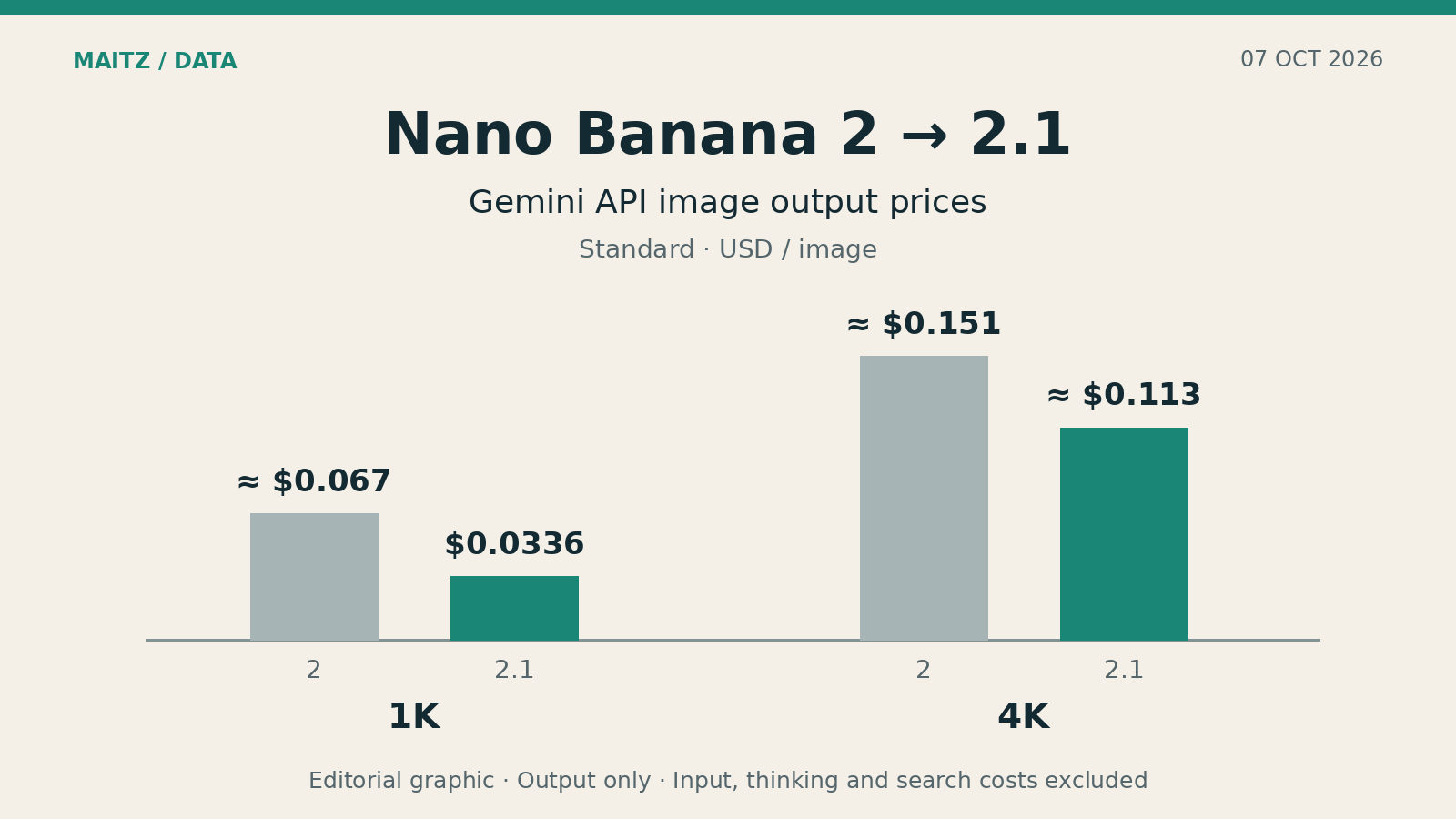
Google made Nano Banana 2.1 generally available in the Gemini API on October 6. Listed as gemini-nano-banana-2.1, the update to its image generation and editing model brings improvements to visual quality, text accuracy and character consistency across multiple editing rounds, according to the company. The pricing change stands out particularly for developers producing large numbers of images through the API.
For current plans, prices and every Maitz article on Gemini, see our Gemini hub.
How Much Does an Image Cost?
At 1K resolution, standard image output costs $0.0336, compared with approximately $0.067 for Nano Banana 2. At 2K, the price is $0.0504, down from approximately $0.101. The reduction is smaller at 4K: approximately $0.113 instead of $0.151. The savings therefore vary by resolution.
These are image output prices only. Input, generated text and thinking are billed separately, while search can add further costs. The new model’s input rate is $1.50 per million tokens, compared with $0.50 for its predecessor; text and thinking output costs $7.50 per million tokens, up from $3. The full cost of an editing task that uses source images may look different from a comparison of individual image prices. These rates apply to the Gemini Developer API, rather than Gemini subscriptions or Flow credits.
What Google Says Has Improved
In its developer documentation, Google lists support for 1K, 2K and 4K generation, improvements to text and infographic layouts, and a fix for unwanted repeating patterns in panoramic images. The model supports combining up to 14 reference images, with a focus on consistency for up to four characters and ten objects. Developers can also select a thinking level and use Google Search to ground generation in information.
The official model card reports improvements in Google’s generation and editing tests, while noting familiar limitations: small text may be blurry, character consistency is not always perfect, and editing with annotations or masks can follow instructions only partially. These results come from the company; we have not independently tested the model.
What to Check Before Switching
For developers already using Nano Banana 2, the practical next step is to compare a few familiar tasks and calculate their total cost, including input and retries. Google has deprecated gemini-3.1-flash-image and recommends moving to the new version. As of our October 7 check, the company had not announced a shutdown date.

