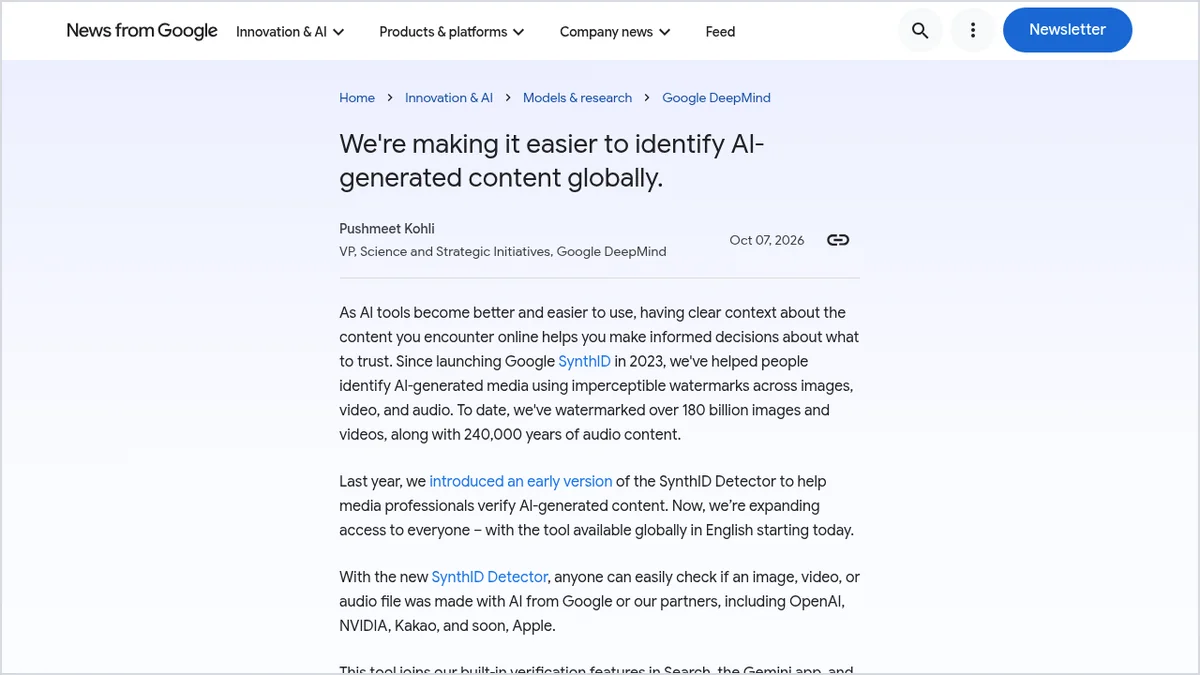
Google announced on October 7, 2026 that it is opening SynthID Detector to everyone worldwide. The tool lets you check whether an image, video or audio file was made with AI from Google or one of its partners. Until now an early version was available mainly to media professionals. Starting today anyone can use it, in English for now.
How it works
SynthID is Google’s technology for embedding invisible watermarks in AI-generated content. It launched in 2023, and Google says it has since watermarked more than 180 billion images and videos, plus audio adding up to 240,000 years. The watermark can’t be seen or heard, but the detector can pick it up. The announcement was written by Pushmeet Kohli, VP of Science and Strategic Initiatives at Google DeepMind.
Not just Google
The most interesting detail is the partner list. According to Google, the detector recognizes content made with AI from Google and from partners including OpenAI, NVIDIA and Kakao, with Apple coming soon. In other words, an image created with one of those companies’ tools and marked with SynthID should be detectable in the same place. It fits a broader trend: we recently covered OpenAI’s plan to watermark ChatGPT text in the EU, and Google itself extended the technology to AI-designed proteins with SynthID Bio.
Alongside the new tool, Google says the verification features already built into Search, the Gemini app and Chrome now handle more than one million requests a day.
What to keep in mind
The detector looks for the SynthID watermark. That makes it most useful for content created with tools from Google and its partners, and Google doesn’t claim it can identify all AI-generated content. If no watermark is found, that doesn’t prove a file was captured or recorded by a person. Still, for journalists, teachers and anyone who runs into a suspicious image or recording online, it’s one more way to check. For readers in the EU, it also lines up with the push for clearer labeling of AI content under the AI Act. More updates in our AI News section.
Sources
- Google, official blog (The Keyword): We’re making it easier to identify AI-generated content globally, by Pushmeet Kohli, Google DeepMind, October 7, 2026

