OpenAI laid out on October 5, 2026 how it plans to meet the EU AI Act requirement that AI-generated text be identifiable in a machine-readable way. The answer from OpenAI is textGrain, an invisible text watermark rolled out in stages: opt-in for API customers starting today, on by default for eligible ChatGPT and Codex users in the European Union over the coming weeks, and detector access limited at first to approved researchers and expert organizations.
For current plans, prices and every Maitz article on ChatGPT, see our ChatGPT hub.
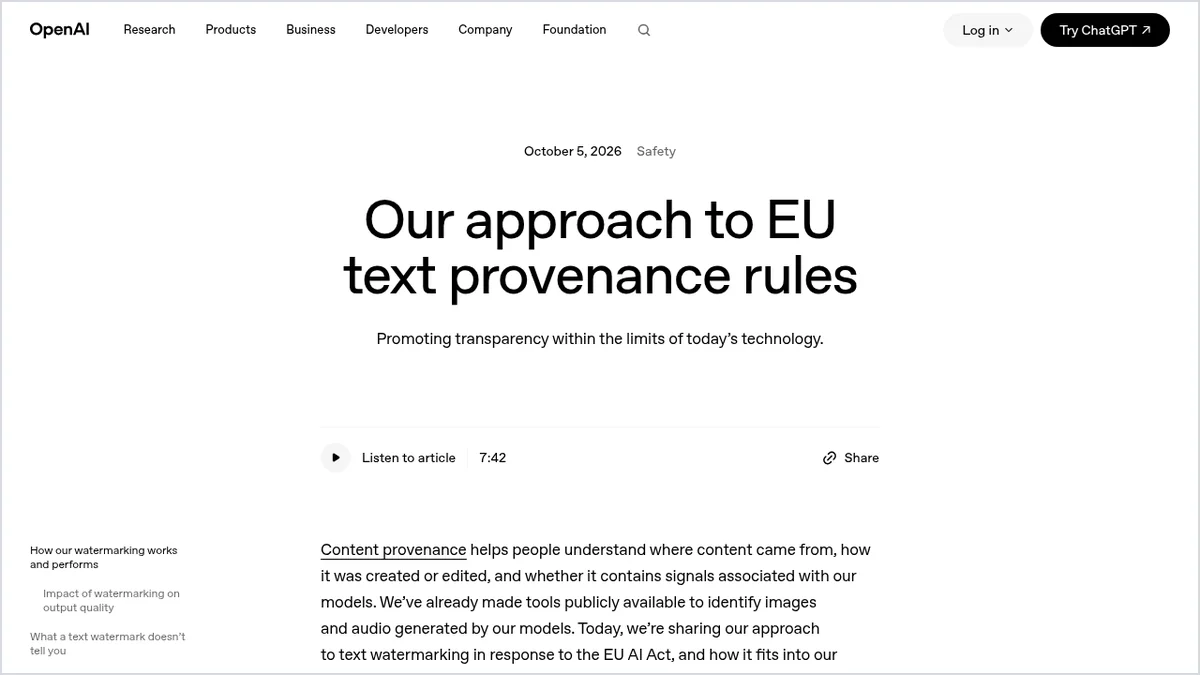
OpenAI is unusually direct about the limits. It calls text watermarking and detection early technologies with significant limitations, and frames the phased rollout as a way to meet the law while being clear about what a watermark can and cannot tell anyone.
What changes, and for whom
- API customers worldwide: starting today, developers can opt in to watermarked text output for select models. Watermarking stays off by default in the API. OpenAI is also working with cloud partners to offer the option for its models accessed through their platforms in the coming weeks.
- ChatGPT and Codex in the EU: over the coming weeks, eligible text output for users on all plans in the EU will carry an invisible watermark. OpenAI says it is not making text watermarking a global default at launch, so users in the US, the UK and elsewhere are not affected for now.
- The detector: applications for access open today, but access will be granted case by case to approved researchers and expert organizations, in line with the EU Code of Practice. The tool reports whether it finds an OpenAI watermark without identifying the user or revealing prompts or conversations.
OpenAI’s existing verification tools for images and audio stay publicly available. The new limits apply to text only.
How OpenAI textGrain works
The technology is called textGrain. It adds an invisible statistical signal to the model’s word choices, and a detector looks for that signal to judge whether a passage carries an OpenAI watermark. OpenAI says textGrain matched or beat the other approaches it tested, including Google’s SynthID for text (we covered Google’s watermarking work in our SynthID Bio story). The company plans to release the technology as open source and to expand its technical report in the coming weeks.
The numbers behind the caution
The announcement includes the weak spots, not just the headline. With the detector tuned to a 1% false positive rate:
- For content such as psychology, it caught the watermark in about 80% of 200-token passages and about 95% of 400-token passages.
- For math content, where there is less freedom in word choice, detection rates were substantially lower.
- Editing weakens the signal: in 400-token passages, swapping 10% of the words for synonyms cut detection from about 92% to 66%, and swapping 25% cut it to 17%.
On quality, OpenAI reports no meaningful difference with and without watermarking across the benchmarks it uses for Astra, its frontier model. On GPQA Diamond, for example, the scores were 94.44% unwatermarked and 93.94% watermarked.
What the OpenAI textGrain watermark does not tell you
OpenAI spells out that a detection result is a narrow signal. It does not measure how much human work went into a passage, does not establish who owns the text or who is responsible for it, does not identify the user and does not say whether the content is accurate. The reverse matters too: no detected watermark does not prove a human wrote it, since short, edited or translated text may slip through, and the text may come from another company’s model. That is why the detector is not public at launch.
What it means for users and developers
If you use ChatGPT or Codex in the EU, your text output will start carrying a watermark you cannot see, with no change to the answers themselves according to OpenAI’s benchmarks. Because the detector does not link text to an account, prompt or conversation, the watermark is not a way to trace individual users, which matters under the EU’s GDPR privacy rules. Developers outside the EU can turn the feature on in the API if they need to meet transparency obligations for European customers. For more on how OpenAI protects its models, see our report on the distillation campaign it disrupted, and follow AI News for updates.
Sources
- OpenAI, official blog: Our approach to EU text provenance rules, October 5, 2026, openai.com/index/eu-text-provenance