Anyone waiting for PlayStation 6 still has no date to mark on the calendar. As of October 7, 2026, Sony has not formally announced a console by that name, shown its design or published a price or launch date. It does confirm investment in its next platform and content for it, while advancing technologies that are already reaching PS5 consoles.
What is already clear about the next generation
In June, Sony discussed adapting its next platform to changing play habits and experiences beyond the living room. This does not confirm a handheld. Memory, processor and performance figures circulating online are not official specifications.
When could PS6 arrive
In its May 8 investor Q&A, Sony explained that higher memory prices increase console manufacturing costs, and passing those costs on to buyers could affect adoption. The company said it had not decided on timing or pricing for its next platforms. At the time, it was preparing for memory prices and supply to remain under pressure through 2027.
In August, VGC reported on a Wall Street Journal interview with Sony CEO Hiroki Totoki in which the launch date was still undecided. Sony also explained in June that launch timing involves technology, commercial considerations, regional conditions and pricing. It is not determined solely by competitors’ moves.
Outside forecasts are not uniform. In July, Ampere analyst Piers Harding-Rolls predicted a launch at the end of 2028. Embracer’s June report cited analysts who believed Sony was considering moving the launch from 2027 to 2028 or even 2029. That is not a Sony commitment or proof of a delay: the company has not announced a date from which the console has been postponed.
Pricing is also open. Sony said in June that it did not intend to sell hardware at significant losses. That is a business position, not a launch price in dollars.
The milestones already made public
Three technologies explain the direction
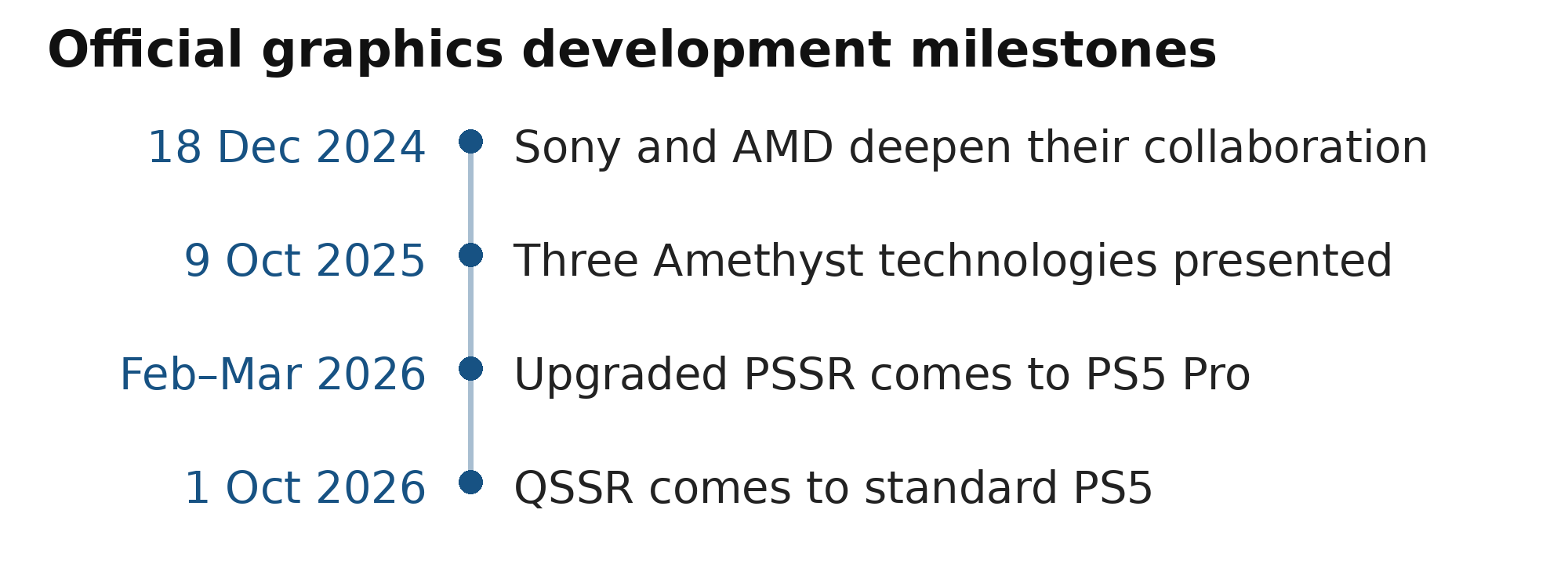
Project Amethyst is a Sony and AMD collaboration. Three research directions were presented in October 2025 and described in an AMD announcement at the time as being in simulation.
Neural Arrays let groups of compute units share data and work together efficiently on machine learning tasks.
Radiance Cores are dedicated hardware for ray traversal, intended to help with ray tracing and path tracing workloads.
Universal Compression compresses graphics processor data to reduce bandwidth requirements. These are development directions, without a promise of a particular PS6 frame rate.
Upscaling and frame generation do different jobs
Upscaling can start with a game rendered at a lower resolution and reconstruct a higher-resolution image from it. AMD’s documentation describes neural networks doing that reconstruction. The goal is to improve the balance between image quality and rendering cost, although the result depends on the technology and its integration into each game.
Frame generation does something else: it inserts intermediate images between frames rendered by the game. Upscaling support therefore does not automatically establish support for frame generation. Nor does Sony’s AMD partnership mean every Radeon feature will necessarily appear in its next console.
What PS5 owners already receive
On October 1, Sony announced QSSR, a lighter AI upscaling option for standard PS5 consoles. It combines a streamlined neural network with an implementation tailored to the hardware. Marvel’s Wolverine and Ghost of Yōtei were the first games to receive it as a graphics option, and Sony plans to make the library available to more developers.
PS5 Pro uses PSSR. Its upgraded version was announced in February and gained broader support with the March 16 update. Sony says it improves image stability and fine detail in supported games. These are improvements to the current generation, and do not disclose the next generation’s specifications.
Discs and compatibility still raise questions
On July 1, Sony announced that production of physical discs for new PlayStation games would end starting in January 2028. Those releases will be sold digitally through PlayStation Store and retailers. The announcement does not affect games already released on disc or those released in that format before the cutoff.
January 2028 has not been announced as PS6’s launch date. The announcement also does not establish whether the next console will include a disc drive, offer a separate drive or support older game discs. Anyone with a physical collection should wait for those details before assuming what can move to the next generation.
What to look for in the official reveal
Beyond price and timing, the upgrade decision will depend on PS4 and PS5 game compatibility, support for existing controllers and accessories, storage options and launch games. Those details have not been fully confirmed for a product called PS6. References to play beyond the living room do not confirm a handheld model either.
On September 23, VideoCardz reported leaker KeplerL2’s claim that the chip design had reached tape-out, the stage at which it is submitted for manufacturing. The report was labeled as a rumor and does not confirm a release date. The picture today is one of active investment and development, with commercial decisions and product details still undisclosed.
Sources
- Sony
- PlayStation Blog
- VGC
- TechRadar
- VideoCardz
- AMD
- Embracer
- Wikimedia Commons
- Creative Commons