OpenAI announced a new ad format for ChatGPT on October 5, 2026: visual ads, built around images rather than text alone. The first test will run during image generation inside ChatGPT, starting later this month in the US with an initial group of advertisers. Alongside the new format, OpenAI is expanding its measurement tools for advertisers and adding partners to evaluate where ads are allowed to appear.
For current plans, prices and every Maitz article on ChatGPT, see our ChatGPT hub.
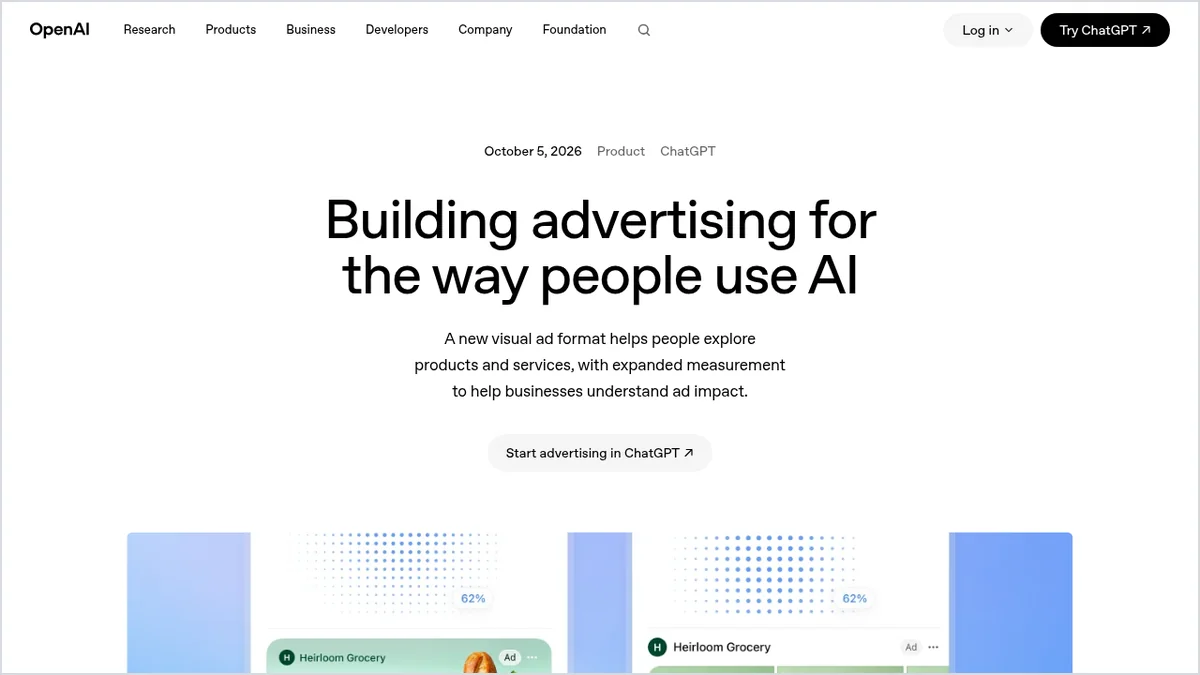
OpenAI says the ads will be clearly labeled and shown separately from the image a user is creating. It also repeats a commitment it has made before: advertising does not influence the answers ChatGPT gives.
What the new ads look like
The idea is to show a product or service in a real-life context: an image that offers inspiration, one that shows the product in use, or one that shows the experience it makes possible. OpenAI pitches this as a way for people to discover new brands and understand what sets them apart, and for advertisers to tell their story visually. People who already use ChatGPT to make images, for example following our guide to consistent characters across scenes, are exactly the audience the first test will reach.
Behind the move is a number OpenAI keeps highlighting: according to the company, ChatGPT reaches 1.2 billion people every week. OpenAI says advertising lets it serve a much larger market than subscriptions alone, and keep offering broad access to people who do not pay.
Measurement: what advertisers get
The second half of the announcement is aimed at marketers. OpenAI is adding integrations with Hightouch, Tealium and LiveRamp so businesses can send conversion data from systems they already use, and it now supports a long list of attribution partners for Conversions API, reporting and click attribution, including AppsFlyer, Adjust, Branch, Singular, Kochava and Triple Whale. It is also working with Haus, Measured and WorkMagic on geo-based experiments meant to show the causal impact of ChatGPT Ads. OpenAI itself describes its incrementality work as early.
The company also shares early results reported by partners:
- According to DV Rockerbox, WeightWatchers’ attributed cost per acquisition on ChatGPT Ads was 15.3% lower than its blended paid-search benchmark.
- WorkMagic reported a statistically significant lift for wellness brand Dose, with 67% of incremental purchases coming from new customers.
- According to Triple Whale, 93% of Portland Leather’s visitors from ChatGPT Ads were new.
These figures come from OpenAI and its measurement partners, not from an independent study.
Where ads will not appear
OpenAI says its placement guardrails check whether a conversation is suitable for advertising, and keep ads away from sensitive conversations and moments when a user may be emotionally vulnerable. Qualifying advertisers can now also set Negative Phrases to keep their ads away from specific topics. To build trust with brands, OpenAI is running brand suitability pilots with DoubleVerify and Integral Ad Science, which will test its safeguards in a controlled environment without access to private user conversations.
What it means for users
For now, the visual ad test is limited to the US, and OpenAI has not said when or whether it will expand to the UK, the EU or other regions. The direction is clear, though. ChatGPT is becoming a full advertising platform, with formats, measurement tools and verification partners like any major ad network, while OpenAI promises that answers stay independent and conversations stay private. If you are choosing an AI assistant for work, see how the tools differ in our Grok Bot vs ChatGPT comparison. More OpenAI news, including the wider rollout of ChatGPT Finances, is in AI News.
Sources
- OpenAI, official blog: Building advertising for the way people use AI, October 5, 2026, openai.com/index/new-chatgpt-ads-format-and-measurement

