The city at the center of the picture
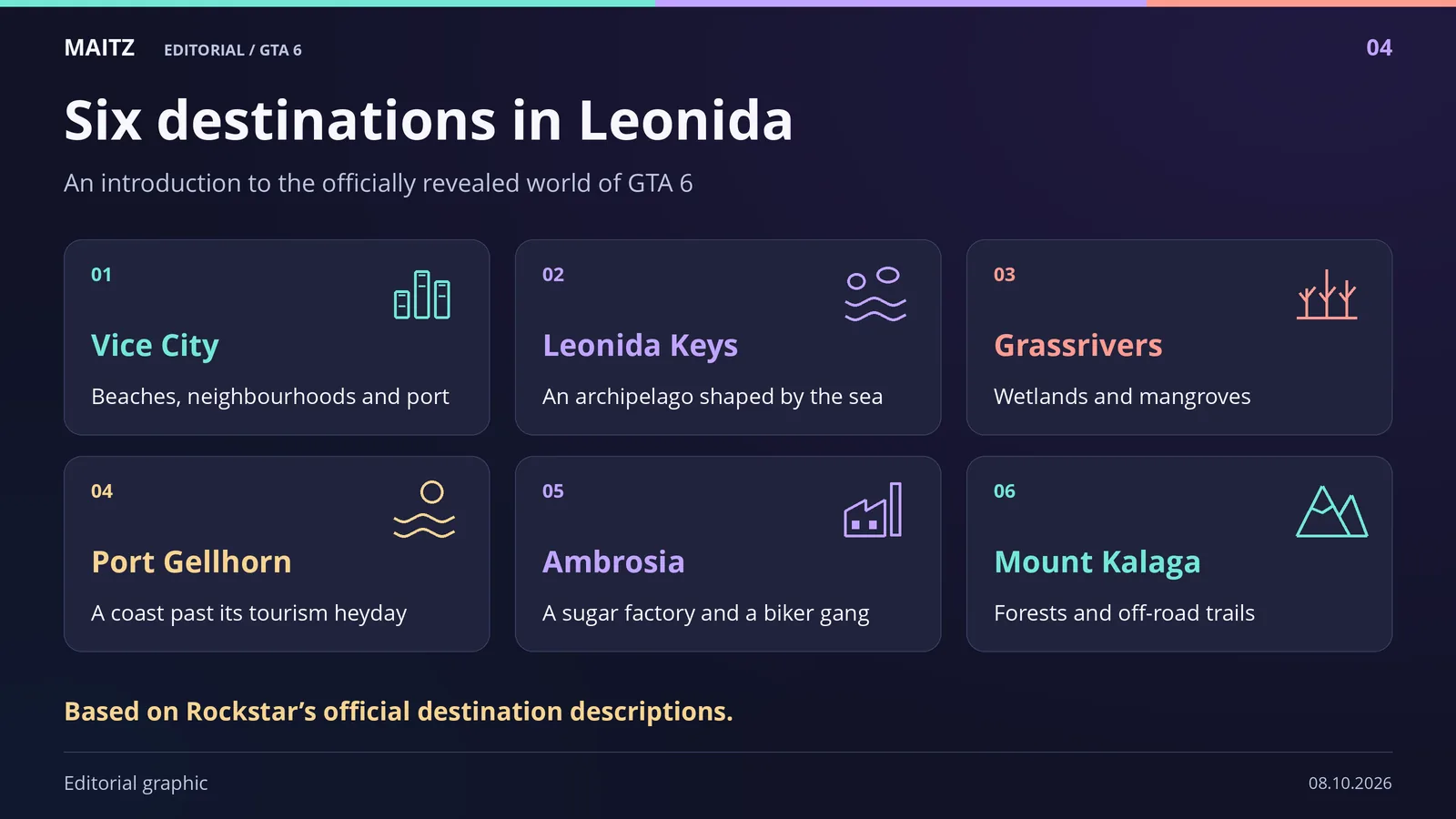
It is easy to start a conversation about GTA 6 on the beaches of Vice City. The name is familiar, the skyline catches the eye, and the city gives Rockstar a clear starting point. The company presents six major destinations on its world pages. To understand where the game is heading, it is worth looking at the places between the big city and the end of the road, too.
This article is part of our complete GTA 6 guide, which collects all of our coverage of the game.
Within Vice City itself, Rockstar names Ocean Beach, Little Cuba, the Tisha-Wocka flea market, and the VC Port area. These locations suggest several sides to the same city: beach tourism, neighborhoods, commerce, and infrastructure. For readers, they offer a better introduction than a single view of the skyscrapers.
Each name also has a role in shaping the atmosphere. A beach crowded with visitors and a local market do not tell the same story, even when they are in the same city. That is the interesting part of this world reveal: the possibility that moving between neighborhoods will change the sense of place, as well as the buildings surrounding the car. This is an interpretation of the artistic direction, which still has to prove itself in the game.
Five destinations that change the scenery
Leonida Keys is an archipelago that puts the sea at the center. Grassrivers offers a different setting of wetlands and mangroves. These two destinations expand the picture of Leonida beyond the city, adding areas where water and vegetation dominate to the official introduction to the world.
Port Gellhorn is described as a coastal destination whose tourism heyday has passed. Ambrosia’s defining features include the Allied Crystal sugar factory and a local biker gang. Mount Kalaga, in the north of the fictional state, is presented as a forested area with off-road trails, hunting, and fishing. These are the company’s published descriptions; they are not a complete specification of the activities or systems in each area.
The contrasts between these places give the journey an intriguing structure. A tourist city, a town worn down by time, and an industrial area can show different forms of money, work, and crime. The question ahead of release is how those differences will come across while driving and meeting residents. At this stage, we can recognize the choice of varied settings without assigning each one a set of missions that has yet to be shown.
Weather enters the picture, too
More details emerged in late September through Game Informer’s cover story. According to the summary published by TechRadar on October 1, the game world is roughly twice the size of GTA V’s. In the same report, Rockstar’s Aaron Garbut describes the attention being paid to building details and interiors. This is reporting on the developers’ statements, not an independent measurement by us; it cannot be used to calculate a precise area in square kilometers. A map assembled by fans from images also remains a community reconstruction, rather than a substitute for a final map published by the company.
The same summary also relays Owen Shepherd’s explanation of more localized, persistent weather, with changing cloud cover and puddles that remain after rain. Around 170 animal species were reported. These details add context to the world shown in the images, but here, too, they describe development ahead of release rather than findings from a test of the finished game.
The interplay between different regions, residents, and weather is more interesting than a competition over square kilometers. A large map can provide space, but a sense of place comes from the differences encountered along the way. Rockstar has already given players several reasons to leave Vice City. Ahead of the planned November 19 launch, it remains to be seen how natural those transitions will feel when we get to choose where to drive.