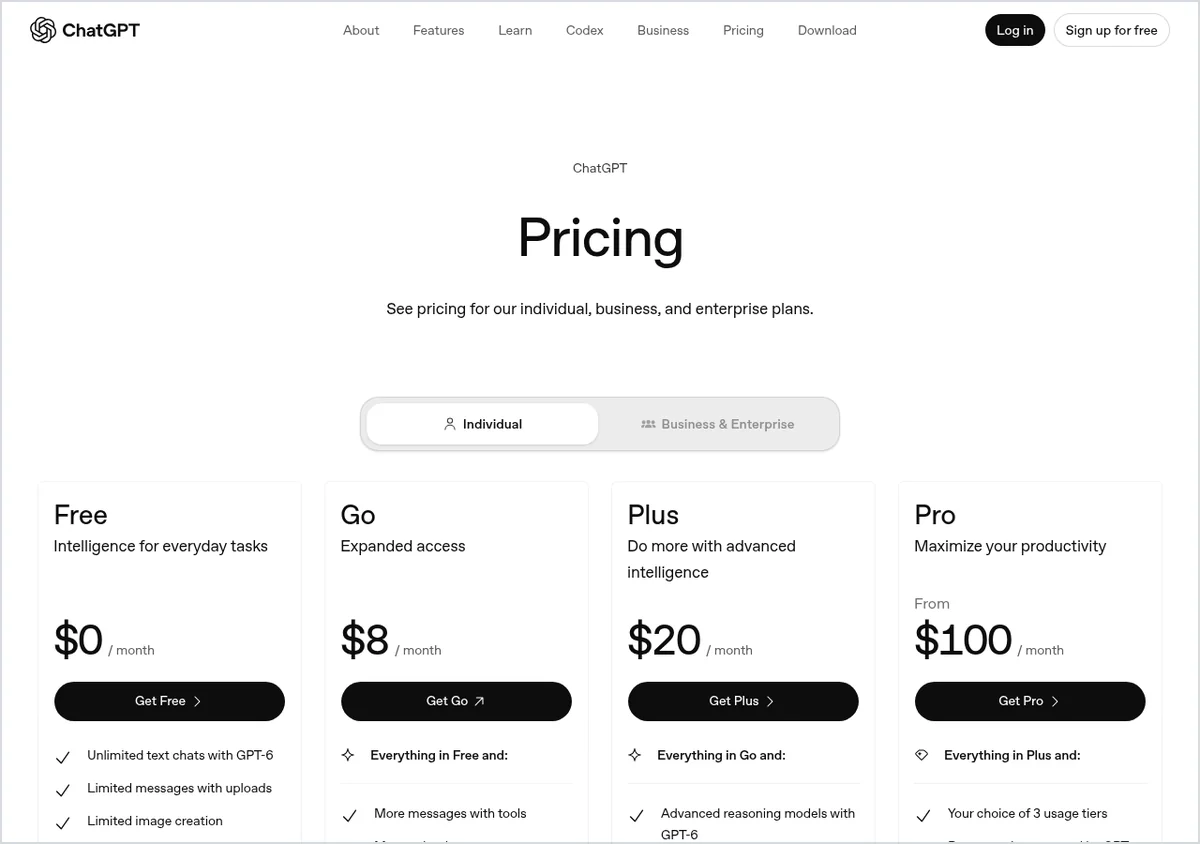
Of the four ChatGPT plans, Free covers everyday text chats for most people. Go at $8 a month suits anyone who keeps hitting file and image limits. Plus at $20 is the cheapest plan with no ads and the full Work agent, and Pro, from $100 a month, only pays off if you use ChatGPT for hours every day.
First look, not tested by us: this review was written on October 11, 2026 from ChatGPT’s pricing page and OpenAI’s Help Center as they read that day. We did not buy a paid plan or measure usage limits ourselves, so there is no score. Our How We Test AI Tools page explains how we label reviews like this one.
For current plans, prices and every Maitz article on ChatGPT, see our ChatGPT hub.
At a glance
- Bottom line: start on Free. Upgrade only when you keep running into the same limit, and pick the cheapest plan that removes it.
- Score: none (first look based on official information).
- Price: Free $0, Go $8, Plus $20, Pro $100, $200 or $500 a month (US prices, checked October 11, 2026). In the EU, UK and Switzerland, your local price appears at checkout.
- Availability: ChatGPT is supported across the US, the UK and the EU, and Go is offered in every country where ChatGPT is supported. Some features, such as Sites, are not yet available in the EEA, Switzerland or the UK.
- Ads: possible on Free and Go; none on Plus or Pro.
For a dedicated first look at image creation itself, see our ChatGPT Images 2.5 review.
What ChatGPT is and who each plan is for
ChatGPT is OpenAI’s chatbot, and it now also includes Work, an agent for longer, multi-step tasks, and Codex for software development. According to the pricing page, everyday chats run on the GPT-6 generation on every plan, Free included (we covered the rollout in our GPT-6 and Intelligent UI report). The plans differ mostly in quantity: how many files, images and research reports you get, how much ChatGPT remembers, and which agent tools are switched on.
One change to know before you follow an older tutorial: ChatGPT agent, the previous agent mode, is no longer available. OpenAI’s Help Center now points to ChatGPT Work and its cloud browser instead.
How we put this review together
On October 11, 2026 we read ChatGPT’s pricing page (which loaded for us in its US version), the help article for each plan, OpenAI’s pages on files, images, Work, Codex, ads, memory, temporary chats and data controls, the supported-countries and billing-currency pages, and both versions of the privacy policy. Every number below appears on one of those pages. Anything we could not find in writing, such as a euro price or a daily image count, is left out.
What each ChatGPT plan includes
| Free | Go | Plus | Pro | |
|---|---|---|---|---|
| Monthly price (US) | $0 | $8 | $20 | $100, $200 or $500 |
| Text chats | Unlimited* | Unlimited* | Unlimited* | Unlimited* |
| File uploads | Up to 3 per day | More than Free | Expanded | Expanded |
| Files per project | Up to 5 | Up to 25 | Up to 25 | Up to 40 |
| Max input per message (Instant model) | About 12 pages | About 40 pages | About 40 pages | About 250 pages |
| Image creation | Limited | More than Free | More complex and accurate, incl. Images with thinking | Unlimited* and faster |
| Deep research | Limited | Limited | Expanded | Maximum |
| ChatGPT Work (agent) | Limited, desktop app | Limited, desktop app | Desktop, web and mobile, incl. cloud browser | Same as Plus, with longer sessions |
| Codex | Limited | Limited | Expanded, incl. Codex Cloud | Longer sessions, incl. Codex Cloud |
| Ads | Possible | Possible | None | None |
* Subject to OpenAI’s abuse guardrails. Limits on images, files and tools change over time, and OpenAI does not publish fixed numbers for them, apart from the three uploads a day on Free. When you hit a limit, ChatGPT tells you and shows when it resets.
ChatGPT prices in the US, UK and EU
The pricing page shows $0, $8, $20 and “from $100” a month, and the help articles confirm Plus at $20 and the three Pro tiers at $100, $200 and $500. OpenAI also gave Go’s $8 price in its worldwide launch post, noting that this is the US price and that Go pricing is localized in some markets. Its Go help article adds that pricing may change over time.
Outside the US, OpenAI’s multi-currency billing page lists euros (EUR) for the EEA, pounds (GBP) for the UK and Swiss francs (CHF) for Switzerland on web purchases. We could not see those amounts on any official page we could read, so we don’t quote them: the exact figure appears at checkout. Subscriptions bought in the iPhone or Android app are billed by Apple or Google in your local currency. There is no annual billing for Go, Plus or Pro, only monthly, and accepted payment methods vary by country.
Free: what you get for $0
The free plan gives you unlimited text chats, web search, file and image uploads, image creation, a Library with 500 MB of storage, limited access to deep research, Codex and Work in the desktop app, and limited memory. Its main weakness is files: three uploads a day and up to five files per project. Audio uploads, such as a meeting recording, are not available on Free at all.
Two more things. OpenAI says ads may appear on Free in certain countries; ad testing started in the US on February 9, 2026 and is rolling out to select regions (background in our report on visual ads in ChatGPT). Where ads are live, Free users can switch to an ads-free mode with fewer messages and no tools such as image generation or deep research. Also, creating new GPTs is no longer possible on any personal plan; you can only use existing ones.
Go: who $8 is enough for
Go includes everything in Free, plus more messages with tools, more uploads, more image creation and longer memory. Think mode is available, audio uploads are included because Go is a paid plan, and projects hold up to 25 files instead of 5. It fits someone who summarizes several documents a week, creates images for social posts or keeps hitting the daily Free limit, but doesn’t need an agent.
What Go leaves out: no cloud browser in Work, no Codex Cloud and no event-triggered tasks (for example, acting on a new email). Ads may appear on Go too. If you want ChatGPT to carry out tasks on websites for you, Go won’t be enough.
Plus: the $20 plan
Plus adds advanced GPT-6 reasoning models, more messages and uploads, expanded deep research, more memory and context, projects and scheduled tasks, and more complex, accurate image creation, including Images with thinking. Work runs on desktop, web and mobile, with a cloud browser that can fill in forms and complete steps on websites, and Codex Cloud is available to eligible Plus accounts. Plus is also the cheapest plan on which OpenAI says there will be no ads.
The catch: Plus still has usage limits, and they can tighten during periods of high demand. GPT-6 Astra is included on Plus with limited usage in Work and Codex, with optional credits for more.
Pro: $100, $200 or $500
Pro now comes in three tiers, after OpenAI added Pro 500. According to the pricing page, Pro includes everything in Plus, plus Pro reasoning powered by GPT-6 Astra, longer Work and Codex sessions, Dot, the always-on agent (see our Dots explainer), unlimited and faster image creation, maximum deep research and up to 40 files per project.
| Tier | Monthly price | What sets it apart |
|---|---|---|
| Pro 100 | $100 | Entry tier, no Ultrafast |
| Pro 200 | $200 | More usage than Pro 100, no Ultrafast |
| Pro 500 | $500 | Highest usage and the only tier with Ultrafast |
Two practical details. Ultrafast uses your allowance at 8 times the Standard rate and Fast mode at 2.5 times, so speed costs usage. If you had an active Pro 200 subscription at any point between September 22 and September 29, 2026, you keep the previous allowance through October 29, 2026; after that you move to the new, lower allowance at the same $200 price.
Availability by region
- US: all four plans, priced in USD. Ad testing on Free and Go began here.
- EU/EEA and Switzerland: ChatGPT is supported, and Go is offered there as in every supported country. Personalized ads are not initially available in the EEA or Switzerland, and Sites in Codex is not available there yet.
- UK: supported, billed in GBP on the web. Sites is not available in the UK yet either.
Other features roll out by plan, region and app version, so if a setting described here doesn’t appear in your account, it may not have reached you yet.
Privacy and GDPR: what to set on any plan
- Model training: on all four plans your chats may be used for training, and on all four you can opt out. Turn off “Improve the model for everyone” under Settings, then Data controls. The setting also covers Codex tasks. Our guide to opting out of AI training walks through it.
- Temporary chat: it stays out of your history and isn’t used to improve models while it remains temporary, but OpenAI may keep a copy for up to 30 days for safety.
- Ads: on Free and Go you can manage ad personalization under Settings, then Ad controls, where ads are available.
- Who is responsible for your data: OpenAI’s European privacy policy covers the EEA, the UK and Switzerland. It names OpenAI Ireland Limited in Dublin as the controller for people in the EEA and Switzerland, lists the Irish Data Protection Commission as lead supervisory authority, and points UK users to the ICO and Swiss users to the FDPIC.
- Your rights: OpenAI says it relies on legitimate interests to train its models, and the same policy gives you the right to object to processing based on legitimate interests, to withdraw consent where consent is the basis, and to access, correct, delete or export your data, or file a complaint with your data protection authority. Data is processed outside Europe, including in the US, under transfer mechanisms the policy names.
Whatever the plan, don’t paste ID numbers, card details or medical records into a chat.
Which ChatGPT plan should you choose?
- Free: mostly questions, writing and the occasional file summary.
- Go: several uploads a day, regular image creation or audio files, and you don’t mind possible ads.
- Plus: you need reasoning models, serious deep research, Work with the cloud browser, Codex Cloud, or simply no ads.
- Pro 100: only if you regularly hit Plus limits. Consider Pro 200 or Pro 500 only once Pro 100 runs out too.
Weighing ChatGPT against an agent that runs tasks on its own cloud computer? Read our Grok Bot vs ChatGPT comparison.
Pros and cons
Pros:
- A generous free plan for text chats, with no fixed daily cap on messages.
- Go at $8 is a low-cost middle step for anyone who just needs more files and images.
- You can opt out of model training on every plan, Free included.
- OpenAI says Plus and Pro will not have ads.
Cons:
- No euro or pound prices on a page you can check before checkout.
- No annual plan, so no discount for committing.
- Most limits are described as “limited” or “expanded” with no numbers, so it’s hard to know when you’ll hit them.
- Some features, such as Sites, are not yet available in the EEA, Switzerland or the UK.
- Pro is now split into three tiers, and the new Pro 200 allowance is lower than before.
How ChatGPT compares with alternatives
| Tool | Best suited to | Our coverage |
|---|---|---|
| Gemini | People who live in Gmail, Docs and Drive and want AI inside Google’s apps | Gemini review |
| Grok Bot | People who want bots that run tasks and routines on a cloud computer | Grok Bot vs ChatGPT |
| Claude | Heavy writers and document work | Claude hub |
Verdict
ChatGPT now has a clear ladder: Free for chatting, Go for volume, Plus for the agent and reasoning, Pro for nonstop professional work. For most people, the right move is to stay on Free until one specific limit keeps coming back, then pick the cheapest plan that fixes it. Plus is the key step up, because that’s where you get the full Work agent and an ad-free experience.
ChatGPT plans FAQ
How much does ChatGPT Plus cost?
OpenAI lists Plus at $20 a month in the US, billed monthly. In the EEA, the UK and Switzerland, OpenAI bills web purchases in EUR, GBP or CHF, and the exact local price appears at checkout.
What is the difference between ChatGPT Go and Plus?
Go, at $8 a month in the US, gives you more messages, files and images than Free, but ads may appear and it has no cloud browser in Work and no Codex Cloud. Plus, at $20, adds reasoning models, expanded deep research, Images with thinking and the full Work agent, with no ads.
Is the free version of ChatGPT enough?
For text chats, yes: there is no fixed daily cap on text messages. The limit you will feel is files, with three uploads a day and up to five files per project, and Free has no audio uploads.
What is the difference between Pro 100, Pro 200 and Pro 500?
They cost $100, $200 and $500 a month. Pro 200 includes more usage than Pro 100, and Pro 500 has the highest usage and is the only tier with Ultrafast. According to the pricing page, Pro also includes Dot, Pro reasoning and unlimited image creation.
Is ChatGPT available in the EU and the UK?
Yes. OpenAI lists the US, the UK and EU countries among its supported countries, and Go is offered wherever ChatGPT is supported. Some features, such as Sites in Codex, are not yet available in the EEA, Switzerland or the UK.
Can I pay for ChatGPT yearly?
No. OpenAI says annual billing and paying several months in advance are not available for Go, Plus or Pro. Billing is monthly, and you can cancel any time through the platform where you subscribed.
Sources
- ChatGPT: Pricing page (Free, Go, Plus, Pro), US version, checked October 11, 2026
- OpenAI Help Center: “What is ChatGPT Plus?”, “About ChatGPT Pro tiers”, “What is ChatGPT Go?” and “ChatGPT Free Tier FAQ”, checked October 11, 2026
- OpenAI: “Introducing ChatGPT Go, now available worldwide”, January 16, 2026
- OpenAI Help Center: “ChatGPT Supported Countries” and “Multi-currency billing”, checked October 11, 2026
- OpenAI Help Center: “Uploading files and audio to ChatGPT”, “Images in ChatGPT”, “ChatGPT Work and Codex”, “Using cloud browser in ChatGPT”, “Using Codex with your ChatGPT plan” and “ChatGPT agent”, checked October 11, 2026
- OpenAI Help Center: “Ads in ChatGPT”, “Data controls in ChatGPT”, “Temporary chat in ChatGPT” and “Memory in ChatGPT”, checked October 11, 2026
- OpenAI: Privacy Policy and the European Privacy Policy (EEA, UK and Switzerland), checked October 11, 2026